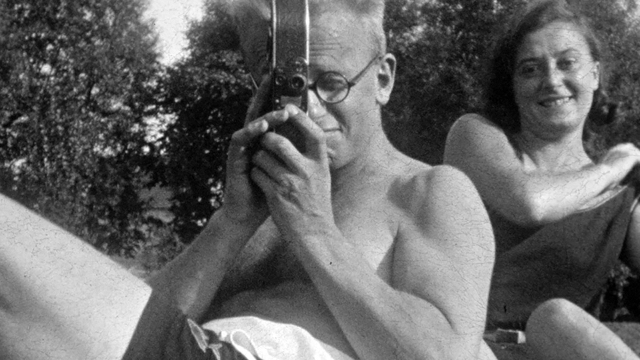
Two young lovers playfully performing for the camera in a German forest, a power plant belching smoke in the background. A zeppelin landing in a field amidst a crowd of excited onlookers. Early X-ray images of human hands and rats. A parade of Nazis marching in a German street, holding a sign advertising a rally for Joseph Goebbels. A low-angle shot of the Statue of Liberty from the point of view of an immigrant arriving by boat in 1931. Views of marble quarries, a barge on the Tennessee River and downtown Knoxville filmed from a biplane in 1937.
These are just a few of the scenes from the film collection of Dr. Walther Barth. A physicist at Germany’s Agfa-Ansco film company in the 1920s, Barth also was a rather skilled amateur filmmaker. Capturing the social milieu of Weimar-era Germany in his travels, Barth frequently turned his 16mm motion picture camera on himself and his friends while also candidly documenting a culture that would soon undergo a great upheaval.
Barth immigrated to the United States in 1931, two years before the Reichstag fire and the ascendancy of the Nazi Party. He continued working as a physicist for Ansco, settling in Binghamton, New York. Over the next few years, he took several road trips across the United States, filming the bright lights of the 1936 Chicago World’s Fair, Southwestern deserts, the Grand Canyon and boxer Max Schmeling at a bout in the Catskills. In 1937, Barth visited East Tennessee, where he took his flight over Knoxville, and filmed in and around the Smoky Mountains, including rare color footage of Ducktown and Copperhill, just before TVA dam construction helped turn their barren land fertile once again.
Late in life, Barth retired to Knoxville, where his son Bill lived and worked as an architect. In 2006, Bill Barth donated his father’s home movies to the Tennessee Archive of Moving Image and Sound. DVD transfers of the 11 hours of film were made, and a screening of one hour of that footage captivated an audience at the East Tennessee History Center. Most of the footage has yet to be seen outside of the family and a few historians and archivists, however, and the film reels, already suffering wear and damage, have deteriorated even more in the last decade and a half.
Realizing the historic importance of the film – not just to East Tennessee but internationally as well – TAMIS realized the best chance of survival for this collection was to apply for a National Film Preservation Foundation matching grant. The NFPF works with the Library of Congress to award federal funds to films that are an important part of the nation’s cultural record and are at risk of being lost forever.
This year, the Walther Barth Collection was awarded $70,000 from the NFPF, with an additional $15,000 of matching funds from the Friends of the Knox County Public Library. The film reels will be sent to Colorlab in Maryland, one of the few facilities in the United States that can create new film prints from 2k-resolution digital scans of the original film. We are in good company, with the American Museum of Natural History, Alan Lomax’s Association for Cultural Equality, the National Gallery of Art, National Museum of African American History and Culture, UCLA, Yale and more than two dozen other institutions receiving NFPF grants this year.
It will be almost a year before TAMIS receives the digital scans and new film prints, and we’re excited to show these remarkable images from the past once they have been given new life. More significant, however, is that Walther Barth’s historic films – unique, personal glimpses into many of the seismic changes that occurred in the 20th century, from Europe to East Tennessee – will be viewable for generations to come.