Musical forces violently collide in a spectacular display of ambition and aggression in Chazelle’s “Whiplash”
Think back to that first week of middle school; clarinet, saxophone, or drum sticks clutched with balmy hands, nervously looking around at classmates wondering if Sarah knew “Hot Cross Buns” as well as Alex, or if Zach could play a full C scale yet in preparation for the big audition.
A whole room is putting their entire weight on a band instructor’s mark of approval, assuming that their initial position in the concert band is going to dictate the fork in their lives leading to fame and fortune, or a lifetime of failure, devoid of talent or hope. For most of these students, the propelling competition leaves within the first few months of practice, but for a select few, that eagerness never dies.
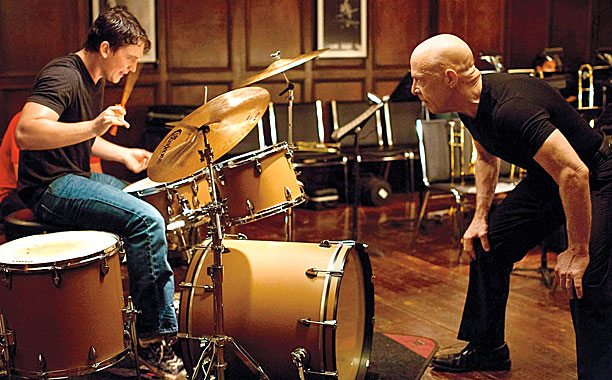
“Whiplash,” starring Miles Teller and J.K. Simmons, tells the story of a tenacious jazz drumming student named Andrew at the nation’s best music conservatory who is placed in the school’s top performance group, under the direction of a violent director prone to berate and beat students at the drop of a hat, or in this case, the intonation of a trombone.
Terrifyingly motivated by this maniacal band leader, Andrew quickly decides that in order to reach his dream of becoming the next Buddy Rich, he has to learn to cope with his instructor’s sadistic teaching methods until he’s utterly broken by the bitter instructor’s untraceable path of acceptance, after he rotates at pleasure between a variety of drummers whose skill and talent Andrew feels pale in comparison to his own.
Andrew’s disregard for the world outside of his studio is consistently heightened throughout the piece. In one scene, Andrew sits down with his father, uncle, and two sporty prep school cousins. Andrew’s accomplishments are briefly touched on, but are quickly cut off in favor of his cousins’ athletic and intellectual feats.
Trying to make his audience aware of his clearly more impressive talents, Andrew alienates his family in his disgust for their lack of respect for how far he has come in his playing. Scorned by the fact that the world around him doesn’t understand his passion, he sheds all connection to it, putting every thing he has, blood, sweat, and tears on his drum kit.
The pacing in “Whiplash” is utterly engrossing. Chazelle takes this realm of music that modern society often pictures as vintage and dusty and injects it with a modern dose of paranoid energy. The camera is constantly propelling itself towards Teller’s face, his booming snare, and his smoldering hi hats, radiating such fierce anticipation towards the climax of each of the film’s three acts that when they end, the audience finally realizes they’ve been subconsciously nodding and tapping along with rapt attention and an even quicker heart rate.
“Whiplash” is very smart storytelling that could just as easily apply to singing, sports, religion or knot tying because it’s the ambition that takes center stage, finely tuned with the incredible musical backdrop. It’s a very dark film; these characters are not bound for glory, instead driving each other downward in a musical catfight leading towards doomed uncertainty.
“Whiplash” is remarkably sure footed stylistically considering it is Chazelle’s first film. Look for some of these performances to make a strong push in award season, and the film to be a dark horse for the movie of the year.