(Note: I helped edit this book. But it’s a good read, anyway.)
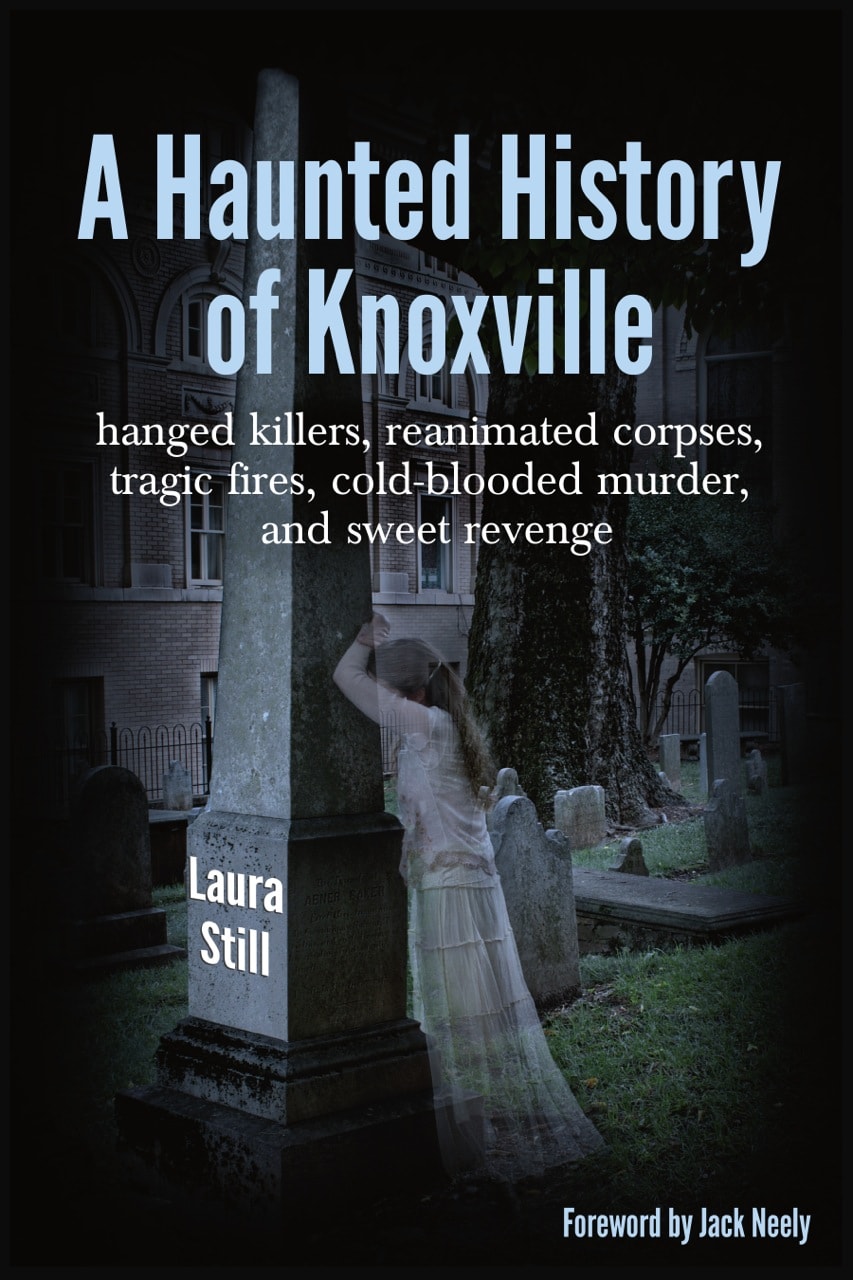
How many ghosts call Knoxville home? Knoxville Walking Tours owner and guide Laura Still isn’t sure, but her new book, “A Haunted History of Knoxville: hanged killers, reanimated corpses, tragic fires, cold-blooded murder, and sweet revenge,” promises “40 chapters of Knoxville’s unique stories of untimely death and mysterious phenomena.” So it’s safe to say that, if ghosts exist, several reside in our storied city.
Still has published collections of poetry and children’s plays, but this is her first foray into nonfiction prose. It developed out of patrons’ interest in the ghost walk she offers among her tours. Those tours, in turn, sprang from Still’s recognition of an unfilled demand among downtown Knoxville’s burgeoning enterprises and her fascination with Knoxville’s past.
A native of upper East Tennessee, Still moved to Knoxville at 20 and has resided here for over 30 years. Jack Neely’s long-running “Secret History” column in Metro Pulse piqued Still’s interest in her adopted town’s heritage. When Still worked at Knoxville’s visitor center in 2006, visitors often asked if a guided walking history tour was available. The answer, to Still’s surprise, was, “No.”
The absence of such an amenity seemed a gap that needed mending. However, the people Still approached about creating a tour suggested she do it instead. And why not? She grew up in a family of storytellers. She had a passion for Knoxville’s history. With Jack Neely and others encouraging her, in 2012 Still began conducting two tours, the “Early Years” and “Gunslingers” walks.
“It was a perfect niche for me,” Still said. “I like to tell stories and I love history, so this is my way of opening up Knoxville to people who aren’t from around here or who aren’t familiar with just how interesting and historic a city it is.”
Based on client requests, she soon added a ghost tour. It proved popular, and in 2013, a publisher suggested that her ghost walk could provide the nucleus for a published collection of local ghost stories. Still liked the idea and began researching sufficient material to fill a book. When the publisher’s contract terms proved unpalatable, Still and her sweetheart and partner, Brent Minchey, decided to publish the book themselves.
The result is a handsome trade paperback, 230 pages thick, filled with tales of local macabre doings and illustrated with 75 images.
Minchey designed the book and was responsible for photographing or finding historical photographs of the properties central to the stories. These histories cover a period from Knoxville’s beginnings as a tiny band of homesteads huddling around James White’s fort near the Tennessee River in the late 1700s to almost the present day, when the city has expanded far beyond the hill upon which it initially arose.
Many chapters focus on the downtown vicinity. One such is the account of the ghosts rumored to linger from the racially charged Red Summer of 1919, when a gun battle raged overnight on August 30 between white and black citizens from hastily erected barricades at the intersection of Central and Vine, near where Central and Summit Hill cross today. The tales range to other parts of Knoxville, too.
To the east, the tragedy and heartbreak that consumed the antebellum Ramsey House Plantation is recalled, among other lore. Out west, the case of the Beast of Middlebrook Pike at the close of the 19th century is at turns comical and alarming, but is less calamitous than other incidents from Knoxville’s western frontier, such as the bloody fate that befell the occupants of Cavett’s Station near the old Kingston Trail in 1793.
The author claims no favorite among the dozens of stories she tells here. Yet her discovery of the gravestone marking the first burial in the Freedman’s Mission Cemetery at Knoxville College may be her proudest research moment. Still had heard accounts of a disembodied girl crying in the graveyard, with no hint who she might be.
Studying the issue, Still learned from Bob Booker’s “The Story of Mechanicsville, 1875-2008” that the cemetery was begun around the turn of the 20th century and that a body had been interred there before it officially opened, the body of an African-American girl who died suddenly while visiting Knoxville with her mother. Reading that, Still knew she had found the ghost.
“The mother just gets on a train and leaves her little girl buried there,” Still exclaimed. “Of course! She’s crying for her mom. It was like a light went on over my head.”
The child was unnamed in the book, but Still later learned it at a lecture on Knoxville College. She and Minchey found the stone near the center of the dilapidated cemetery, standing over the grave of six-year-old Mamie Hampton, who died in 1902.
These details make “A Haunted History of Knoxville” a satisfying read. Terrifying spectral creatures and mourning spirits may be the book’s lure, but the hook is the fact-finding that grounds the unearthly narratives solidly in local history.
If these phenomena are otherworldly entities lingering on, Still has found clues to their origins on this world, in this city. As Jack Neely notes in the book’s Foreword, Still “has combined an open mind with real and diligent library research into very specific stories that aren’t duplicated in other cities … I can guarantee that these stories belong only to Knoxville alone.”
Since the book’s Knoxville launch party October 7, sales have been brisk, and inquiries are mounting about mysterious occurrences at other properties around Knoxville. So the question now is, does Knoxville hold enough ghosts for a second “Haunted History?” Still laughs and says, “People coming on the tour are already asking me. People who have bought the book are expecting one.” So it appears the answer is, “Yes.”
For information on buying “A Haunted History of Knoxville” or more information on Knoxville Walking Tours, go to www.knoxvillewalkingtours.com.