


There are six metrics most widely used by analysts in order to rank teams in the NCAA tournament. These include the NET, the KPI, the SOR, the BPI, the KPOM and the SAG. For transparency’s sake, let’s break down each of these metrics before we get into specifics.
The NET (NCAA Evaluation Tool): This is the end all be all of college basketball analytic metrics. It was designed by the NCAA to replace the RPI. A very important aspect of the Net is ranking wins and losses across 4 quadrants that are determined by the strength of an opponent and the location of the game. These designations are as follows and are quoted ad hominem in terms of analyzing the strength of a team’s record across college basketball.
Quadrant 1: Home 1-30, Neutral 1-50, Away 1-75
Quadrant 2: Home 31-75, Neutral 51-100, Away 76-135
Quadrant 3: Home 76-160, Neutral 101-200, Away 135-240
Quadrant 4: Home 161-353, Neutral 201-353, Away 241-353
The KPI: In my opinion, this is the most convoluted of the 6 metrics. Developed by Kevin Pauga, an associate AD for Michigan State, the KPI attempts to rank every team’s wins and losses in a negative to positive scale. Worst possible loss is a -1 where the best possible win is a +1.
SOR (Strength of Record): This metric attempts to rank a team’s schedule by how hard or easy its overall record would be to achieve. Things included in this analytic are travel distance, pace of play, opponent strength, site, day’s rest and altitude.
BPI (Basketball Power Index): An analytic designed by ESPN, the BPI attempts to take RPI to a new level, accounting for more than just winning percentage. Injuries and the site of the game are two of the many intricate factors that are included in arriving at their results.
KPOM: Ken Pomeroy, a professor at the university of Utah, has been publishing his tempo based college basketball analytics since 2002. He is considered a guru and he has perfected his college basketball predictions relying on a possession-by-possession analytical basis. A specific aspect of his analytics is offensive and defensive efficiency.
SAG: Jeff Sagarin has been publishing his computer analytics in USA Today since 1985. Sagarin ratings have been used across all sports, most influentially in college basketball and football. Sagarin doesn’t divulge the specifics of his rating system, but his ability to predict future results over the past 30 years speaks for itself.
I woke up Sunday cautiously optimistic that the University of Tennessee men’s basketball team would win its first conference tournament championship since the three point line was invented. My only worry was the low key chatter that Tennessee would do no better than a three seed in the NCAA tournament even if it did so. When my worst fears were realized, I had no choice but to dive deep into the analytics and from the looks of the metrics the NCAA points to as barometers of their process, a few teams got worked, including Tennessee.
This article will be full of caveats.
Caveat number one, and probably the biggest reason why you should stop reading now: I am not a journalist. I’m just a pissed off dude with an unhealthy fandom for anything University of Tennessee who just so happens to have a friend that owns a newspaper. Apologies in advance to Rusty Odom.
The best case scenario is I can be seen as the voice of the popular masses. Worst case, I’m a homer with an agenda spinning a conspiracy theory as to why the man is always holding my beloved Volunteers down. Either way, I have one thing that the selection committee never seems to pony up… NUMBERS!
| Committee Rank | Average Rank | Team | Deviation from Ave | NET | KPI | SOR | BPI | KP | SAG | 6 metric ave | Conf RS | Conf Tourney |
| 5 | 9 | Auburn | +4 | 11 | 6 | 6 | 12 | 10 | 12 | 9.50 | y | n |
| 6 | 5 | Kentucky | -1 | 5 | 9 | 5 | 4 | 3 | 6 | 5.33 | n | n |
| 7 | 8 | Villanova | +1 | 8 | 7 | 8 | 7 | 11 | 9 | 8.33 | n | y |
| 8 | 12 | Duke | +4 | 12 | 14 | 11 | 11 | 12 | 11 | 11.83 | y | n |
| 9 | 20 | Wisconsin | +11 | 24 | 8 | 10 | 28 | 34 | 20 | 20.67 | y | n |
| 10 | 6 | Tennessee | -4 | 7 | 4 | 3 | 5 | 7 | 7 | 5.50 | n | y |
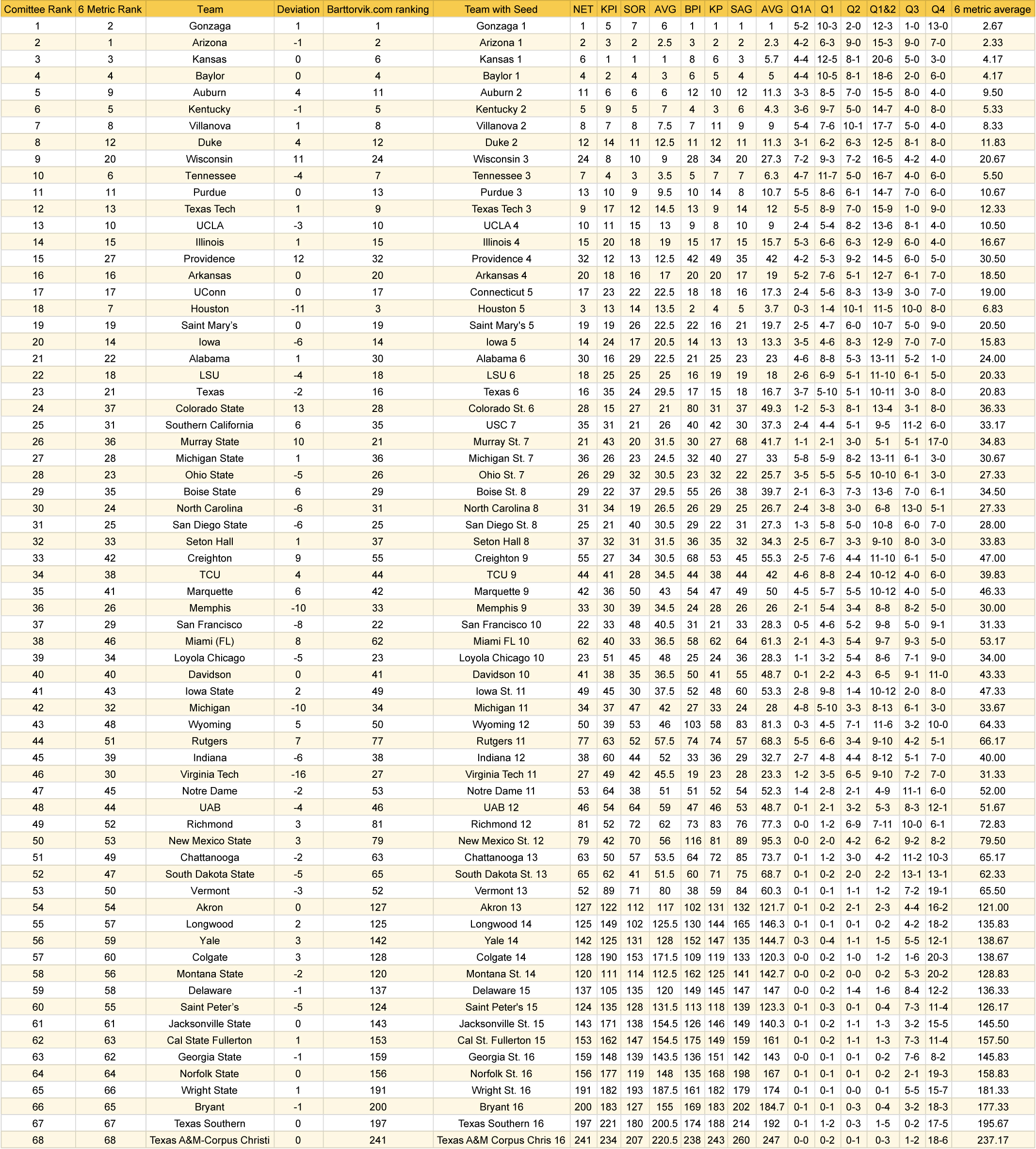
To convey my point, I am going to break down some data, including the committee’s own rankings and six metrics that the NCAA selection committee supposedly uses in order to pick the at-large teams in the NCAA basketball tournament, seeding them from best to worst.
This is a convoluted process. There are a total of 68 teams that receive “bids” to play in the tourney. 32 of those teams receive automatic bids based on the fact that they have won their respective conference tournaments.
Caveat number two: Bellermine won its conference tourney but didn’t get a bid due to NCAA rules An additional 36 teams receive tournament “bids” based upon their body of work throughout the season. The committee has their hands full.
They have to assess the 32 automatic bids and then choose the 36 most righteous clubs to round out their most important tournament to decide who is the greatest team in the land.
As most readers already know, Tennessee received a three seed in the tournament. Essentially the committee is saying that the Volunteers rank somewhere between number nine and 12 in their findings.
The committee actually releases the rankings of each team from one to 68, providing a glimmer of transparency as to why they placed each team in their respective seed. For the sake of simplifying this argument, let’s just assume that the committee got the top four teams correct.
The number one seeds in the 2022 tournament are Gonzaga, Arizona, Kansas and Baylor (in that order). I fundamentally agree with this selection, even though I think you could make a decent argument that Baylor could have fallen to a two seed, and that Arizona is the most deserving of the number one overall seed. According to the metrics, Arizona got the worst of the deal. The Wildcats have three teams in their bracket that, again according to the numbers, should be a two seed (Tennessee, Houston and Villanova). Gonzaga, on the other hand doesn’t have a two seed in its bracket. The highest ranked team in the Zags region is Duke, who sits at 12 in the metrics.
Moving on to the focus of this piece, let’s look at the second line. The four teams selected for two seeds in order were number five Auburn, six Kentucky, seven Villanova and number eight Duke, in that order. (In an almost impossible coincidence, Tennessee played 4 of the top 8 teams with a record of 4-2, we will discuss their record against those teams later). As if this wasn’t enough to make the Tennessee faithful scratch their heads, it was also revealed that the first three seeded team (number nine ranked team by the committee) was Wisconsin. Tennessee was ranked tenth overall.
According to the raw data, the two seeds should have been ranked Kentucky, Tennessee, Villanova and Auburn, in that order. This disregards the fact that Tennessee has played three of these teams a total of five times with a record of 3-2 (2-1 vs Kentucky, 1-0 vs Auburn and 0-1 vs Villanova with an additional win over one seed Arizona). Tennessee definitely gets the advantage on head-to-head matchups but let’s look at the analytics.
Of the six teams we are looking at, Tennessee is the only team that falls within the top eight in each poll. Tennessee’s average ranking across all analytics is 5.5, second only to Kentucky. The major outliers are Duke at 11.83 and Wisconsin sitting at an astonishing 20.67 average.
To make matters worse, none of these teams won both their conference regular season title and their conference tournament. The only team on this list to have done neither is Kentucky.
Lets dive into the all important NET component of “quadrant wins and losses.” Of the five teams considered, Tennessee owns the most “quad 1” wins with 11 (second most in the country behind only Kansas with 12), while Duke had the fewest with 6. That being said, losses outside of “quad 1” are considered major upsets. Tennessee has zero losses outside of quadrant 1. Duke had 4, Wisconsin had 4 and Villanova had 1.
Caveat number three: The committee’s job includes looking outside the analytics. There is a need to balance the data with factors that aren’t incorporated like injuries to important players and coaching turmoil. The problem here is that Tennessee suffers from neither of these negative aspects.
Bottom line: Something was amiss on selection Sunday. ESPN analyst Joe Lunardi, who makes his living predicting NCAA tourney brackets, was emphatic that Tennessee wouldn’t rise above the three line now matter what it did in the SEC Tournament to the astonishment of his colleagues at ESPN. When the bracket came out, Lunardi was right, but couldn’t give an understandable explanation as to how he could have possibly known that. Was the bracket set before tournament play? Did Lunardi rely on inside information from the committee? Is the committee corrupted by a desire to protect blue blood programs at the detriment of the truly deserving? Would this have happened if it wasn’t Coach K’s final season? Check the numbers and decide for yourself.






Wow, that writer is gorgeous! Never been so attracted to a man just based on written words in my whole life.