Experimental music, film, art the focus of festival held March 27-29
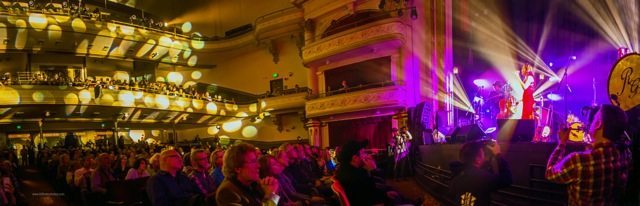
As Knoxville Mayor Madeline Rogero confirmed in her speech at the kickoff ceremony to the 2015 installment of Big Ears on Friday evening at the Knoxville Museum of Art, the festival has been instrumental in refining the cultural identity of the host city. Having risen 40 percent from 2014, daily attendance figures seem to substantiate this claim. No longer simply a moderately sized university town, Knoxville is now seen as a prime travel destination for tastemakers and trendsetters taking part in what is widely considered to be the country’s premier gathering of avant-garde musicians, artists and filmmakers.
In what ultimately proved to a microcosm of this year’s Big Ears, the kickoff began with artists-in-residence the Kronos Quartet and Chinese pipa master Wu Man performing an impromptu cover of a movement by 2009 headliner Philip Glass. Drawing hushed reverence from the sizable crowd of festival attendees, media and Knoxville dignitaries, the performance was an astute example of improvisation and perfectly indicative of the adventurous, collaborative spirit that defines Big Ears and which distinguishes it from all other music festivals.
Kronos made six more appearances over the next two and a half days, performing alongside a diverse array of musicians that included experimental maestros (Terry Riley, Laurie Anderson), folk heroes (Rihannon Giddens, Sam Amidon), world-music standouts (Tanya Tagaq, Wu Man again) and bona fide rock stars (Nels Cline, Bryce Dessner). Neo-classicist composer Max Richter directed the American Contemporary Music Ensemble (ACME) in one performance of his material, and he led the Knoxville Symphony Orchestra, violinist Yuki Numata Resnick and ACME in another.
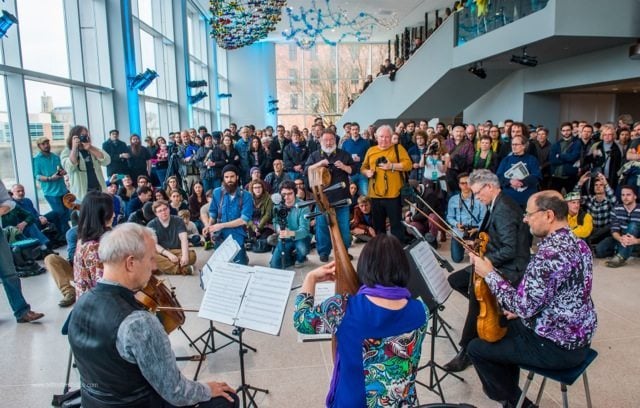
Kronos Quartet at the Opening Party
Photo by Bill Foster
Myriad genres were represented throughout the weekend, as well. The Standard, with its spacious confines and excellent sound and light systems, served as the de facto home for electronic music. Sweaty dance parties broke out abruptly amid the pulsating synths and throbbing bass of artists like Jamie xx, Clark and Omar Souleyman. The Bijou Theatre, while durable enough to have held up superbly to aural assaults by Swans and Ben Frost, boasts acoustics ideally suited to the most technical of musicians (The Bad Plus, Bill Frisell). The Tennessee Theatre yet again proved its worth as a world-class listening room on a variety of occasions. Only the poor design of the Square Room detracted from the performers who graced its cozy Market Square stage.
Bustling around the periphery of Big Ears was a torrent of events both sanctioned by the festival and operating independent of it. The expanded film program offered relief to attendees in need of a break from the jam-packed music itinerary; the Regal Riviera and the KMA both screened top-notch flicks from acclaimed directors, the latter venue even allowing visitors in for free each day. Printmaking studio the Striped Light ran letterpress workshops for festivalgoers, and Saw Works Brewing Company, whose Sonic Wit was the official Big Ears beer, led attendees on discounted tours of its facilities. Competing, concurrent fringe festivals (Hello City, Funny Ears, Big Asses) were the proverbial icing on top of an already loaded, delicious cake.
Although temperatures remained cooler than the seasonal average, conditions improved steadily over the course of the three days, culminating in a beautiful final day. Foot traffic around the downtown typically was brisk, but new public art installations, a digital rendering of Riley’s In C and Found Sound Nation’s street studio provided welcome distractions in and around Krutch Park.
If there were a negative to be gleaned from this year’s edition, it is the fact that the highly conceptualized performances – of which there were many – did not enthrall in the same way as they did in years past. Perhaps it was the sheer number of collaborations or the lack of spark therein, but it seems as though Big Ears would benefit in terms of impact and longevity if in succeeding years it were to feature a more streamlined lineup and were to incorporate at least a couple of hip-hop artists. Featuring local acts like it did in its first two iterations might be a good idea, as well. Given the extraordinary nature of the festival, complaining about such things may appear petty, but it is food for thought.
During his address at the kickoff event, Big Ears creator Ashley Capps branded Rogero “the coolest mayor on the planet.” Certainly not fallacious (though it sounded cheesy at the time), the statement especially rings true in retrospect. For at least one weekend out of the year and obviously thanks to the festival, Knoxville is guaranteed to be positioned at the center of the avant-garde universe. It’s a distinction befitting the city’s rich progressive history, and hopefully it is an indicator of what is yet to come.
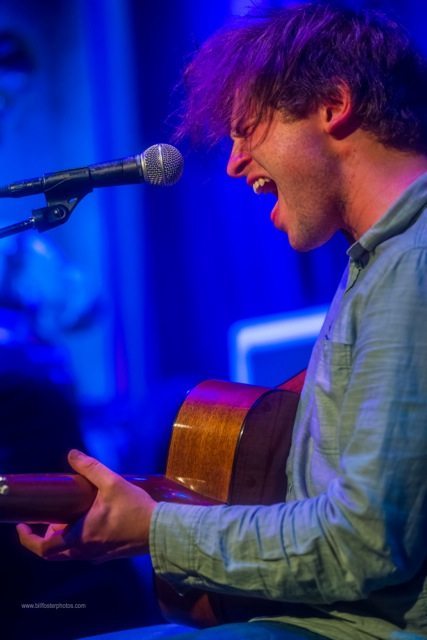
Ryley Walker
Photo by Bill Foster
Nosaj Thing
The first thing I encountered upon entering the spacious main room of the Standard was the measured cool of Jason Chung’s frosty rhythms booming from a high-grade speaker stack from each side of the stage. (I eventually would have to move back from my spot stage right to preserve my hearing for the rest of the festival.) The second thing I noticed was the professional-quality light show that was happening around me. At the same time the L.A.-based producer was busy warming up the festival crowd with an engaging deejay set, the venue was establishing itself as an indelible location for electronic music.
The Bad Plus
Translating Igor Stravinsky’s fabled “The Rite of Spring” in a single take, the modern jazz trio simplified the composition without stripping it of its raucous fever. Leading the proceedings while grinning like a madman, drummer Dave King smashed his kit with precise ferocity. King’s accomplices matched his acumen, their combined interplay rivaling that of a full orchestra. Though it didn’t cause a riot like the original performance, it was ample proof of the power that just three players can generate. It also was the closest thing to last year’s most dynamic rendering of a single piece: Dawn of Midi performing the entirety of their Dysnomia album on the same stage at the Bijou.
Kronos Quartet/Wu Man
Like each night of the festival, Friday was teeming with must-see shows. Consequently, I was able to catch just about 15 minutes of this performance of The Cusp of Magic. Written by Terry Riley exclusively for the four-piece and the Chinese multi-instrumentalist, the piece is childlike in its celebration of harmony. Buoyant and even humorous on record, the live interpretation nevertheless sounded elegant. Notwithstanding the tail end of “Emily and Alice,” of course, the found sounds of which elicited laughter from the otherwise reserved audience.
SQÜRL
There’s no denying that seeing noted indie film director Jim Jarmusch play guitar was the main reason why so many festivalgoers crammed into the Square Room to see his band on Friday evening. What they were treated to, however, was a better-than-expected set of meandering psychedelia that at its best would snap into focus after periods of indolence. One of the more mainstream Big Ears performances, it satisfied the crowd’s rock jones while still pushing creative boundaries.
Clark
Although the Englishman’s recorded material comes across as icy and distant, there was a warmth and immediacy to his live set. Frankly, I didn’t expect it to suck me in as much as it did, but I soon found myself bouncing like a lunatic around the back of the Standard in between note-taking sessions. Projected onto a screen behind him were myriad landscape vignettes, collectively mimicking the worldliness of the music.
Demdike Stare
Entering the darkened Bijou a third of the way through the live scoring of Häxan: Witchcraft Through the Ages after experiencing the vibrancy of what the Standard had on tap, I was ill prepared for the creepy cocktail the duo was administering. In normal circumstances, I likely would have thoroughly enjoyed the spectacle, but I didn’t last more than 10 minutes in the joint.
Jamie xx
Clearly a man on a (funky) mission late Friday night at the Standard, the producer/deejay brought down the house with a dynamite turn behind the boards. Spinning with a deftness and intensity not often seen, he paid special attention to the transitions between tracks, masterly annexing the end of one to the beginning of another. The R&B-infused material was perfectly suited for cutting a rug, and the crowd obliged with frenzied dancing from start to finish.
Kronos Quartet/Sam Amidon/Rihannon Giddens
My Saturday began with a mind-blowing experience at the Tennessee Theatre courtesy of artists whose output I have enjoyed over the years but by whom I didn’t expect to be moved so deeply. Exploring both domestic and international folk catalogues, Amidon and Giddens conjured magic. The former, with his distinctive croon, tugged at heartstrings with traditionals written in the distant past, while the latter displayed a stunning range on hymns and spirituals dating back to the days of slavery. Kronos, as they did throughout the weekend, offered nonintrusive yet crucial accompaniment to the tunes.
Two moments in particular struck me during this performance. One involved the jaw-dropping vocal acrobats Giddens displayed while covering a Gaelic traditional; the other occurred during Amidon’s last song. Already floored by the singer’s heartbreakingly sad lyrical delivery atop the quartet’s brooding instrumentation, I was utterly devastated by the fiddle solo that followed. Bow raised and glinting in the stage light, a second later it met violin for a sound more emotionally resonant than anything I had ever heard before in my life. It evoked the stark finality of death and left me covered in goosebumps and with tears streaming down my face. Conferring with my wife afterwards, it appeared I wasn’t the only person to have had such a reaction.
Holly Herndon
Herndon was one of the few artists to begin late. After a false start and an unfortunate incident in which an attendee fainted near the front of the stage, the Johnson City native regrouped to put on one of the most interesting and beguiling performances of the weekend, replete with a multimedia experience that had to be seen to be fully appreciated. Frustratingly disjointed at times but featuring pockets of sublime brilliance, the music fluctuated between grinding, mechanical tones that fit the industrial environs of the Standard to more melodic structures, most of which came at the denouement. In fact, the abrupt cessation of the music proved a bit of a letdown, though one that – like the technical music itself – likely was predetermined.
Kronos Quartet/Laurie Anderson
This was a much-lamented performance, and for fairly good reason. Visually unappealing and requiring patience from listeners, the artistic enactment of Landfall, Anderson’s ode to Hurricane Sandy’s wrath, wasn’t for the faint of heart. However, it did offer some high points, as well. Taken at face value, the entire thing played out like a surrealist dreamscape; vocoder effects augmented her voice midway through the reading as the luscious strings ebbed and flowed throughout. Interesting enough, for sure, but I concur with the attendee who I heard anoint the show as the best during which to take a nap.
Max Richter
I wish I could offer more in the way of a legitimate review of this show, but it was so insanely crowded that any criticism I could level from my limited perspective would be largely unfounded; I stood in the balcony for five minutes before succumbing to claustrophobia. Even Ashley Capps, who organized the whole freaking festival and who came in shortly after me, was unable to find seating for what seemed like a wonderful program. After retreating to the stairwell, I, along with at least 20 others, were left awestruck with what pleasant ambient drones could be heard through the closed doors.
tUnE-yArDs
Only its abbreviated length kept this set from feeling like a show independent of Big Ears. Aside from those at standing-room-only venues like the KMA and the Standard, it was the first performance to feature an audience that stayed on its feet for the duration, and the convivial atmosphere, while not exactly running counter to the festival at large, provided a refreshing change of pace to what could have been construed by the masses as stuffiness. In front of a massive, neon pink sheet, the band hit an impressive stride with material culled mainly from the last two releases.
Merrill Garbus’ voice was as strong and impressive as it is on record; it and the show peaked with “Powa,” the tempo-shifting slow jam from w h o k i l l. Entertaining and evocative, that individual performance easily asserted itself as a contender for best-of-festival. And for what it’s worth, I found myself thinking “tasty groove” more than once during the set at the venerable Tennessee Theatre.
Grouper
I’m sorry, but I have to editorialize here. As a sucker for music fashioned by misanthropic, talented female singer-songwriters, I had been looking forward to this show since the initial artist announcement and long before the daily schedules were finalized. But when it was revealed that it was booked for the Square Room on a Saturday night, I let out an audible groan.
To be fair, I have seen a boatload of fantastic concerts at this venue – the Hold Steady, Fruit Bats, Sharon Van Etten and Neon Indian to name just a few – but drawbacks like the unusual shape of the space (literally a square room) and the ill-conceived entry points always have detracted from my personal enjoyment of the music.
Unfortunately, Liz Harris’ set was affected thusly by the same factors. Due to the adjoining Café 4’s closure concurrent to the performance, no one was allowed in or out of the rear doors and all incoming traffic was routed to the door stage right. The bastard orientation might have sufficed for a more boisterous artist, but it was completely unwelcome in this scenario. Already feeling like an intruder when I arrived mid-set, I was forced to remain rooted to my spot by the impenetrable crush of people surrounding the stage and blocking passage to the rear of the venue.
Nestled on the floor down-stage, the notoriously reclusive musician eschewed the upright piano featured so prominently on her most recent album in favor of an electric guitar and feedback generated from the two small amp stacks between which she sat. Despite her surroundings, Harris made the best of the situation, delivering beautiful melodies wrapped in delicious, hazy reverb.
Ben Frost
Last year, inexplicably long delays at the Bijou marred what otherwise was a perfectly organized festival. Fears of a similar inconvenience for this late-night show were alleviated, however, when festivalgoers were allowed entry after a minimal wait in the outdoor foyer. Once inside, they were treated to a deafening wall of noise courtesy of the Iceland-based Australian and a surprise team of two percussionists and a guitarist. Dissonant and abrasive yet shockingly harmonious, the overall result was riveting enough to have kept me on the edge of my seat, tapping my toes all the while. From my vantage point, I couldn’t tell, though, whether or not Swans’ drummer Thor Harris, who played on Frost’s most recent record, was manning one of the kits.
Tyondai Braxton
In spite of a nasty cold that surfaced early Sunday morning, I made my way to the Standard for the last of three performances of Braxton’s HIVE project. A hybrid art exhibit/musical event, the setup in the small room adjacent to the main hall comprised five art-deco metal pods, each occupied by a musician, three of which were percussionists. The two modular synths were the stars of the show, though, somehow lending an antiquated organic texture to the computerized electronic score. Not quite danceable, but wholly engrossing nonetheless, the spectacle scratched the proverbial itch of anyone who, like me, had missed out on the previous performances but who had been curiously wondering about why those structures were in place.
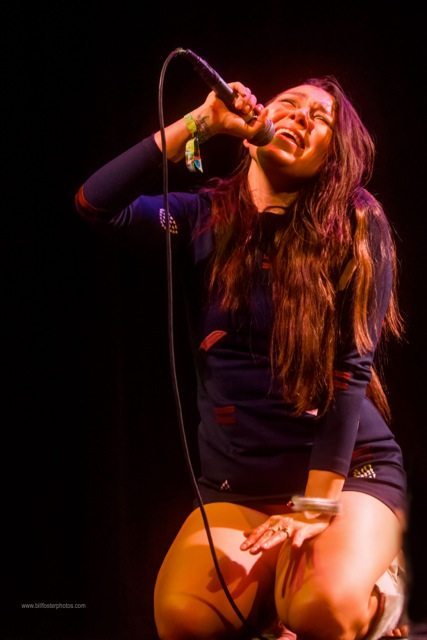
Tanya Tagaq
Photo by Bill Foster
Kronos Quartet/Bryce Dessner/Tanya Tagaq
Known primarily for being the lead guitarist for straightforward rock act the National yet having most recently forged a solo career as a modern classical composer, Bryce Dessner wrote a movement celebrating the 40th anniversary of Kronos entitled (appropriately enough) 40 Canons, and Big Ears attendees witnessed the pair’s first continental live performance of the piece Sunday afternoon at the Standard. Beginning with what sounded like a radio transmission, it skirted experimental territory traversed by Godspeed You! Black Emperor before settling into a taut, intricate rhythm.
Having the day before missed what two trustworthy friends both described as being one of the top-five shows they had ever witnessed, I thought it best to catch Tagaq with Kronos. The throat-singing wizard from Nunavut, though by all accounts toned down as compared to how she was during her solo performance, still made quite an impression with her distinctive stylings. Whether it was good or not is open to interpretation, but at the very least I appreciated the fact that I was being exposed to a genre that I had never previously encountered.
Perfume Genius
In previewing the festival, I mentioned Mike Hadreas’ only previous stop in Knoxville, an opening slot for Beirut in which he was noticeably shy and presumably self-conscious. Well, times have changed, and he commanded the stage like no other performer was able over the course of the weekend. Shimmying, shaking, entertaining and entrancing, he captivated a near-capacity Tennessee Theatre audience on Sunday evening.
Alternating between dancing seductively and sitting demurely behind electric keys, he maintained a kinetic flow from song to song. Engaging lightheartedly with the adoring audience between tracks, Hadreas would every time regain a singular focus once the next number began. It was a supremely professional performance, yet it never came across as scripted or insincere. Waiting until the end to deliver “Queen,” his best and most popular song, Hadreas belted it out with determined conviction before bowing and waving to the audience, walking offstage and letting his equally adept bandmates finish playing the immaculate glam-rock stomp to a well-deserved standing ovation.
Swans
There is no way to accurately describe to anyone not at the Bijou that Sunday night the magnetism, intensity and sheer volume of this performance. In other words, you were either there to see the venomous thunder visibly shake loose globs of dust from the rafters or you weren’t. Michael Gira and company stretched the tense “Frankie M” to the breaking point twice before climaxing with an earth-shaking finale. All the folks front and center stood up and went wild at the conclusion of the song, everyone else in the theater following suit immediately after Gira motioned for them to do so. The band followed it up with “A Little God in My Hand,” Christopher Pravdica’s rollicking bass purl the clear highlight. Thor Harris, as per usual, brought the merciless savagery, pounding the skins with reckless abandon.