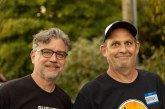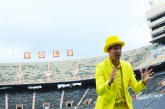
Adeem the Artist is, according to his own website’s description, “a wandering loon; unconventionally sad, astronomically sincere, and anatomically correct.”
As that quote reveals, Adeem is also adept at summarizing himself and distilling his own essence, throwing in a little tongue-in-cheek dilettante silliness to boot. Those same qualities of intense self-awareness morphing into self-deprecation that make his romping, whimsical folk songwriting so hooky, ebullient, affecting and memorable also make him an easy and engaging interview.
“I wish I could have latched onto a metaphysical combo meal and ridden one out.” for example, he says about his spiritual meanderings across the years of his youth. No soundbite needed there; he speaks in idioms, maxims and quotable quotes.
Originating in Syracuse, New York and surfacing first under the stage name Kyle Adem in the late 2000s, Adeem Bingham wasted no time in releasing a flurry of albums, EPs and singles, prolific from the start. Bingham had grown up with the puzzling combination of fervent religious upbringing and a family history of struggles with substances. He’d thrown himself into the religious part first; in fact, his first few albums Family of Strangers EP (2010), Living Room Tapes (2011), Armor (2012), had such implicit religious themes that he’s had a difficult time reconciling it with his current work since losing the faith and dabbling in many other philosophies and lifestyles.
“It wasn’t lowkey on the religious content,” Adeem says of his earlier work, laughing. “That’s a fraction of what’s been released and pulled.”
Likewise the material was voluminous in part because, as a fervently, almost zealously religious young artist, he says, it was hard to imagine editing or revising anything that he was inspired by God, he thought, to write. ” I discovered this song, so I can’t revise it,” he remembers thinking each time he’d write a new song. It made his songs more frenetic, free-association practices in the early days, he says.
Adeem recalls the big switch; through a rough breakup around the time of Armor’s tracking, and other factors, he started to question a lot of what he’d put so much stock in, and eventually, he says, “I was an atheist by the time that was done.”
The immediate response, and many an angry young person’s answer during questioning times, was turning to substances, which Adeem spent a drinking-from-the-volcano period in (but now has little to do with); then of course, the feelings and thoughts he was grappling with bled over into his art.
An angry phase of cognitive dissonance at losing his love and his faith ensued, resulting in 2013’s Syracuse, an album that is now discontinued for some of its graphic lyrics he’s not as proud of today. “I’m pretty temperamental,” he admits. “Always on the wrong side of the coin.” For this same reason Adeem, while occasionally using accompanists, has never settled down with a band, opting mostly for the sparse solo acoustic arrangements that let his voice and his wild mind free. “Mostly I do stuff myself,” he says. “My musical style is very frenetic.” And without a band to tie him down to a timing or volume mix, he says, “there isn’t a single rule.”
One silver lining moment from that time period is the 2013 single “I Go On,” which Adeem was able to license to Discovery Channel, a rare big success in a road that he admits has been a hard struggle as an emerging solo artist.
In Knoxville, Adeem briefly signed with Ghost Motel Records and released the 2014 EP Beautiful Dreamer, but due to some business and creative differences, he went independent soon after.
Originally presenting as more clean-cut, stylish and earnest indie-folk, Adeem says that after his transformation out of religion much seems silly and without stakes or overt meaning; therefore, he has embraced eccentric sounds, sometimes irreverent lyrics, and taken to dressing in a more bohemian fashion, having fun with facial hair and hats and jewelry and artful clothing and visual designs for his work, aided in these pursuits by his painter wife, Hannah.
Hannah designed the cover for Adeem’s bold new statement album Kyle Adem is Dead. It depicts a tree, the symbol of nature, life, age and wisdom, splitting pictures of two sides of Bingham’s face. His current Adeem the Artist face, replete with handlebar mustache and mischievous twinkle in his eye is juxtaposed beside his Kyle Adem face, more serious and somber, with a large red X over the eye, symbolizing a version of himself now dead, a phase of life that has run its course.
The album has a diverse sound and urgent tone, at times playful, frenetic and wild and at times soft and subtle. He goes from low, whispered spoken word over playful finger-picking and riffs to growling and yelping over thrashed open chords.
“Good Ship Jesus” sounds like an acoustic Dan Auerbach, and “Goodbye,” “Waiting” and “Quiet Songs,” a meta-song about songwriting all smack of Colin Hay or Mountain Goats or Brett Dennen.
Adeem is making the rounds around town, integrating nicely into the scene since moving here, despite his feelings otherwise. For someone who just started in town a few years ago, he has begun to make a name for himself, playing the WDVX Blue Plate Special, the Ghost Motel Sessions and the Sharing Needles With Friends podcast. He goes to the monthly songwriter’s night headed by Karen Reynolds and he has an upcoming show with Blond Bones, Joey English and My Politic at Central Collective on September 26. He will have a new Kickstarter campaign for his next project later in the month.
All the descriptions aside, the simplest way to put it is Adeem the Artist is a songwriter’s songwriter. Honest, confessional, witty, passionate, and animated in conveying his unique take on the world around him. He says he’s thought about taking a break from it all after some poorly attended shows lately; we at Blank can’t discourage that adamantly enough.
Go see Adeem the Artist on the 26th. His is a personality and sound too interesting to live in the same town with and not go experience.