Baseball is a game of failure.
Ask any student of the game and they’ll tell you that.
No one in Major League Baseball history has ever had a career batting average over .366. That means that that six and a half times out of 10, even the best hitter in the history of the game did not achieve his goal.
On the pitching side, you’ll gain what is called a “quality start” if you throw at least six innings while allowing under four runs. The ultimate goal is to not allow any. So no matter if you’re the batter or the pitcher, you’re going to lose more than you win.
Baseball is the epitome of the saying, “If at first you don’t succeed, try, try again.”
Jesse Cole understands that.
He’ll be the first to tell you that when he started the Savannah Bananas in 2015, he didn’t really know what he was doing. But he had a few things that money can’t buy: passion, perseverance and patience.
In an era ruled by bottom lines and greed, Cole is charting a new course. And it’s not just for himself.
The groundwork he is laying with this venture will impact an immeasurable integer of future entrepreneurs. Simply put, what he is building will not just be remembered, but also studied until the end of time. And even if you never catch a single inning of Banana Ball, you’re better off because it exists.
It’s not about the money for Cole. It’s about passion and creation and not selling to the highest bidder when fortune and fame come calling. It’s sticking to the mission and not saying no to even the zaniest of ideas when they’re presented.
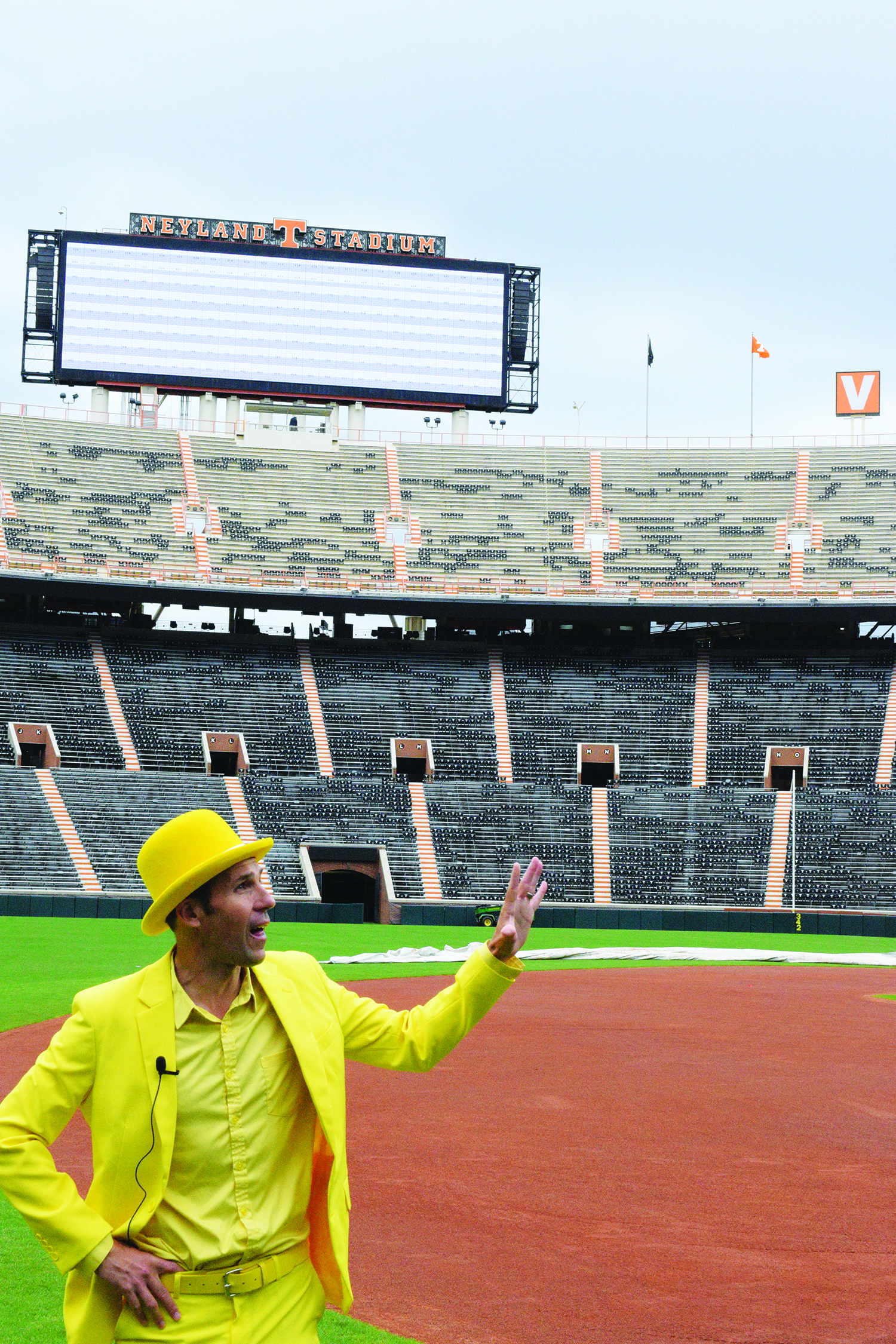
As drizzle fell on the temporary baseball diamond at Neyland Stadium on the morning of May 23, Cole was kind enough to grant two independent outlets a cut of his time. There were no TV cameras or fancy microphones in sight. It is, evidently, part of the Bananas’ mission to highlight the scrappier sources of information in the towns they visit. The following is the inspiring conversation I had with the man inside the yellow tuxedo.
BLANK Newspaper: So you’ve been very inspirational to me personally. I love that you kind of lean into the things that you’ve done wrong throughout the journey. It’s really cool to see somebody not be embarrassed by those missteps because there are so many people out there watching. Those people are going make mistakes, too. Is that just kind of who you are, or do you recognize that it’s really important to give that information to other people?
Jesse Cole: I’ve experienced a ton of failure. When I was a kid, I played baseball. I struck out a lot, and when I pitched, I had games where I got shelled.
I was fortunate that I had the opportunity to play in college, but then I went to Division I baseball, and I’m playing against the best players in the country. I went 1-9 my freshman year, and I had an ERA over seven. I don’t talk about that much, but I experienced failure at the Division I level.
And then when we started our team in Gastonia with only 268 dollars in the bank account, no one was coming to the games, so I experienced failure there. Then with all the crazy promotions we tried – like the dig to China nights, the grandma beauty pageants, the salute to underwear nights, the flatulence fun night – I experienced a lot of failure. Then we went to Savannah, and that was the ultimate failure because when we started, we only sold a few tickets, and we ran out of money within three months.
We had to sell our house and empty out our savings account. We failed. And then, when we left to go do Banana Ball, people thought that was the biggest mistake we could make.
Then we went to the one city world tour, and so many things went wrong in that first experience, from the sound going out to our promotions failing … we failed. And then in our first Major League stadium, the ticket system shut down. For our first game on ESPN, we lost the transmission.
There’s no blueprint for doing any of this. We’re writing it, so you’re going to fail in the beginning. For our first time doing a stadium of this scale in front of 102,000 fans at Texas A&M, we didn’t do the best job. We were trying to entertain and get in the upper deck and do so much, but we didn’t do everything up to our standard. But we learned a lot.
And so now we’re here, and we’re going to get better. I think the key is just to keep showing up. You keep doing it and keep learning, and you learn by doing. Most people are afraid, and once they fail, they give up. We’re going to keep going, it’s gonna be hard, and we’re gonna let some people down on the way, but it’s going to be better in the long run.

BN: You seem to be the epitome of, “An L is a lesson, not a loss.”
JC: There’s no such thing as a loss, and I don’t think you can even look at it as a failure. You know, as a kid, we’re taught that if we get a big F on our test, then we failed. It’s just about learning. It’s about discovering. Every failure is on your path to success. The key is just to keep showing up and keep coming to bat.
BN: It makes sense that baseball would be where you learned this persistence.
JC: That’s how I learned it. I failed so much playing baseball as a kid that now it’s not really failure. The people that keep playing the game are the ones that win. As Walt Disney said, you got to keep plussing the experience. We’re going to get better at the upper deck today. We’re gonna get better on the field. We’re not going to try to do so much. Instead, we’re gonna do a few things really well. That’s how we get better.
BN: You mention Walt Disney a lot. When did you have that first moment of awe that you still seem to possess today?
JC: My parents surprised me with the trip when I was 8 years old. I’ll never forget it. I was on the plane [and] they said, “We’re going to Orlando to go to Disney World,” and when I heard it for the first time … it was magical. It’s a different world. In many ways, I believe that we’re world building, and that’s what Walt Disney did.
This universe of Banana Ball never existed, and at one point Disneyland never existed. Disney World never existed. He built a world of joy, of happiness, of bringing people together and of magic. And I think what we do with everyone singing and dancing from the ages of 2 to 82 and beyond … we’re a part of this experience. I learned that from Walt.
You walk in and you see the train, and you’re going through the tunnel, you see the castle for the first time, and you’re seeing this unbelievable world that didn’t exist. I was blown away, and that always stayed with me. He built that from nothing. I love building things from nothing and then seeing people say, “Wow, what is this place?”
BN: You take a lot of chances. I’ll try almost anything because I’m a little bit of a dreamer, but you might be the biggest dreamer on the internet right now, so it’s really good to see. I’m sure you had a lot of people tell you that these things weren’t going to work, though.
JC: What most people don’t have is belief. Or they get into it for the wrong reasons. They get into it because it could be a good business or it’s a trending business. They think, “We can make money doing this, and I can sell it and make a lot of money.” But when you believe in something, you feel it. When you’re out there with the fans for hours after the game and people come up to you crying, saying they’ve waited three years to get in, and they tell you how much it meant to them – that’s it.
People challenge us every day. Every single day, [we hear] “This is a fad. Their 15 minutes is up. They jumped the shark. This won’t work. They’re a disgrace to baseball.” Every day we get that. But those people haven’t felt what I’ve been able to feel and what our team has been able to feel and what our cast has been able to feel.
The love, the joy, the belonging … this is what people want. People are hungry for this, and so you keep telling us it’s not going to work, and we’re going to keep showing up.
And when it’s hard, we’re going to do the hard things and [people can] keep doubting us. I’m excited about people that doubt us because I’m going to look back in 10 or 20 years and say that we stayed true to who we are, what we stand for and we kept showing up.
That’s the joy. When you understand that as an entrepreneur you’re doing things because you believe in it, because you truly believe in it, you’re unstoppable.
That’s what I believe in.
BN: It seems like you’ll give almost everything a shot. How big is your pool of people who come up with these ideas, and how do you keep it so that there are not too many cooks in the kitchen?
JC: Creativity is contagious. When you start spreading creativity, people want to be a part of it. The best ideas aren’t individual ideas, they’re our ideas.
There are two mindsets in life. You can have an abundance mindset, or you have a scarcity mindset. I’m good with sharing everything we do. If I believe in it and it can help other people and we can work together to create something truly special, spread it.
There are a lot of companies out there that try to hide everything. I understand it might be best for business in the short term, but if your goal and your vision is much bigger in the long term to spread joy and bring happiness to everyone, then share it and don’t keep a small circle. Let everyone learn and let everyone grow. When people say, “What about your competitors?” I don’t spend a second thinking about it. I focus on our fans and how to create a better experience every day.
The competitors are irrelevant because you are obsessed with doing what’s best for the right reasons. So we come up with ideas constantly and we share them internally and we share them out in the public. I’ll get out and tell everyone what we’re doing because I think it’s for the world. Often, when we come up with an idea, I’ll just go out and share to people just to see how they react. If I get a laugh or if I get joy, we’ll lean in on that. If there’s confusion, then maybe we need to work more on that idea.
I think sharing, in many ways, shows that you truly care about something, and it shows that you’re not afraid of someone else taking it.
BN: You’re obviously not monetarily driven here. This is passion. But when did you know that you were going to be OK on the money side?
JC: Not on January 15, 2016. That was the phone call that we received that we had overdrafted our account and we were out of money. I’m 31 years old, my wife’s 28 and we had just gotten married three months prior to that. We’re out of money. At that point, I did not know.
But then, when we named the team the Savannah Bananas, that created attention. We got some negative feedback, but people said, “I want to give this a shot.”
And then on the first night, we sold out that stadium. And after that show, and I saw how people reacted, I said, “We don’t need to think about money anymore.”
We need to think about how we create this experience and replicate it and make it better and plus it every single day. And I’ll tell you – this is the honest to God truth – I have one financial meeting each year, and it’s less than two hours.
Everything is all about creating something special. We have a great team. They know how to keep us healthy, and I’m focused on trying to create joy. And when you spend your energy doing that, the money takes care of itself.
The Savannah Bananas will take Shields-Watkins Field at Neyland Stadium at 7:00 p.m. this evening in front of a crowd of over 100,000. The event is sold out.