MONDAY UPDATE: Now that the festival has come to a close, here are our recaps of each day:
Day One: Thursday • Day Two: Friday • Day Three: Saturday • Day Four: Sunday
We’re off and running. Here are our highlights from day one of Big Ears 2026.
The Last Critic
The first few hours of Big Ears actually have very little live music. The earliest events are often films and other programs that have a musical subject. “The Last Critic,” the debut film by director Matty Wishnow, is a loving portrait of prickly music critic Robert Christgau, the self-professed “Dean of Rock Criticism.” Both the title of the film and Christgau’s honorary title are pretty much on target. With appearances by other renowned critics (Greil Marcus and Nelson George, among them), fellow Village Voice writers, family members and the subjects of Christgau’s reviews (Randy Newman and Thurston Moore are standouts), Wishnow captures both his subject’s historical importance and current relevance.
The film follows Christgau in the final days before turning in his most current “Consumer Guide” books of reviews to his publisher and include others (sometimes the subjects themselves) reading his reviews. Christgau’s summations are snarky and intelligent, sometimes flattering, sometimes dismissive and cruel, but always honest to Christgau’s opinions. Lou Reed hated him enough to trash talk him on a live album. Thurston Moore wrote him angry letters. And, in contrast, his favorite still-working band Wussy credit his reviews with much of their popularity. The relationship between Christgau and his wife, fellow writer Carola Dibbell, is sweet and even inspirational. Despite the publication deadline, there’s no real dramatic arc to the story. It’s more of a portrait, but it’s very entertaining and a nice way to spend an hour and a half, especially at the beginning of a music festival. – Wayne Bledsoe
The Gladson Family Band
It’s always been such a delight that, while the festival offers tons of opportunity to experience the avant-garde and ultra-modern, it always makes room for the time-tested traditional sounds of various cultures, including that of the festival’s home here in Appalachia.
The Gladson Family out of Hancock County was absolutely charming and incredibly talented onstage at Boyd’s Jig & Reel Thursday night. Mom, dad and their three older children manned guitars, fiddles, stand-up bass, banjo and mandolin to delight the audience with both well-tested bluegrass gospel and favorites, along with some autobiographical originals. They covered country legend Little Jimmy Martin’s “Tennessee” and the Stanley Brothers’ “Dream of a Miner’s Child” along with a Roan Mountain Hilltoppers instrumental, switching instruments throughout the set. They also told us all about the family’s current, ongoing land disputes with the hilarious “Hey Bob” and “Litigation.”
The quintet’s humble and humorous interactions with both the audience and each other were so delightfully refreshing and soul-cleansing, right down to the gentle ribbing between their three teens. Local folk can catch them regularly at the Cumberland Gap Small Farmers Market or one of their fundraisers for the Hancock Junior Appalachian Musicians where the family teams to keep the old-timey sounds alive for future generations. – Jennifer Duncan-Rankin
Essential Tremors: Maria Chavez
Another non-concert aspect of Big Ears is the array of interviews and podcasts, including “Essential Tremors,” an interview podcast co-hosted by former Metro Pulse music writer Lee Gardner. In the 2 p.m. recording session featuring turntablist Maria Chavez, Chavez had three pieces of music played and discussed why she loved them and how they had affected her. Yet the most surprising thing she revealed was that she had gotten death threats for her habit of breaking vinyl records in performance in order to get the sounds and effects that she wants. It made you wish that she could demonstrate her work rather than only discuss it. Still, there’s time for that later at Big Ears. – WB
Knoxville In Music History: Jack Neely
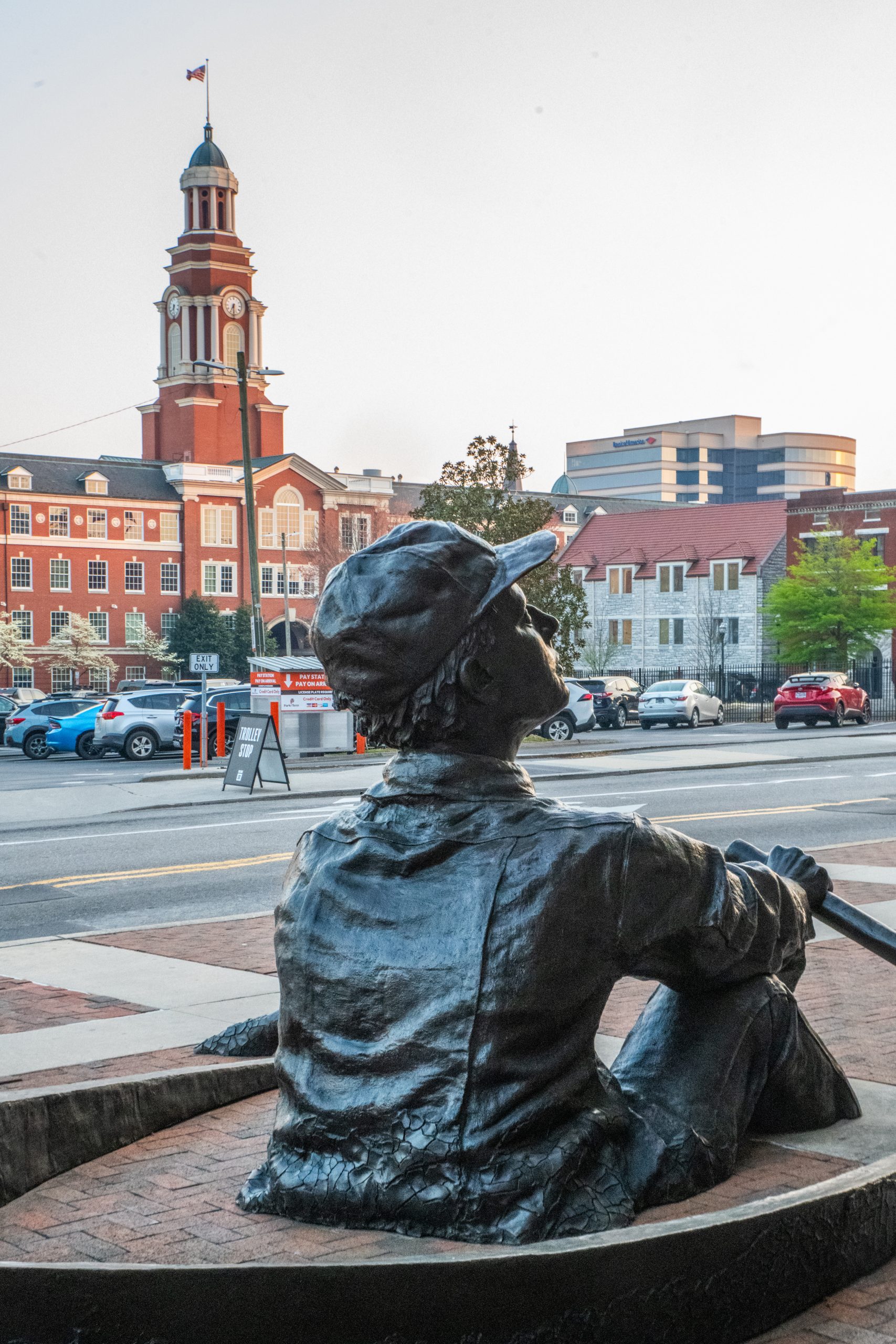
Big Ears always has free events, which is a nice gesture considering that many Knoxvillians cannot afford the price of a Big Ears weekend. These are often presentations by local artists. Longtime journalist and Knoxville favorite Jack Neely, who is part of the organization The Knoxville History Project, gave an informative introduction to the regularly ignored importance of Knoxville’s place in music history. No one digs into the city’s ancient history with such lovably nerdish enthusiasm. While Neely found it impossible to cram everything about the city’s music history into one hour, he summarized about 130 years of history (stopping in the 1960s) as best he could. It was peppered with great details, including things like country legend Roy Acuff’s history of criminality before he became a star and the importance of the Knoxville-born gospel greats The Swan Silvertones and their influence on songs by Paul Simon, Creedence Clearwater Revival and the Grateful Dead. Neely acknowledged that people might ask why an event such as Big Ears would be held in Knoxville. With the wealth of Knoxville music history in the town, the answer would be the question: “Why not?” – WB
Dither Play Laurie Spiegel
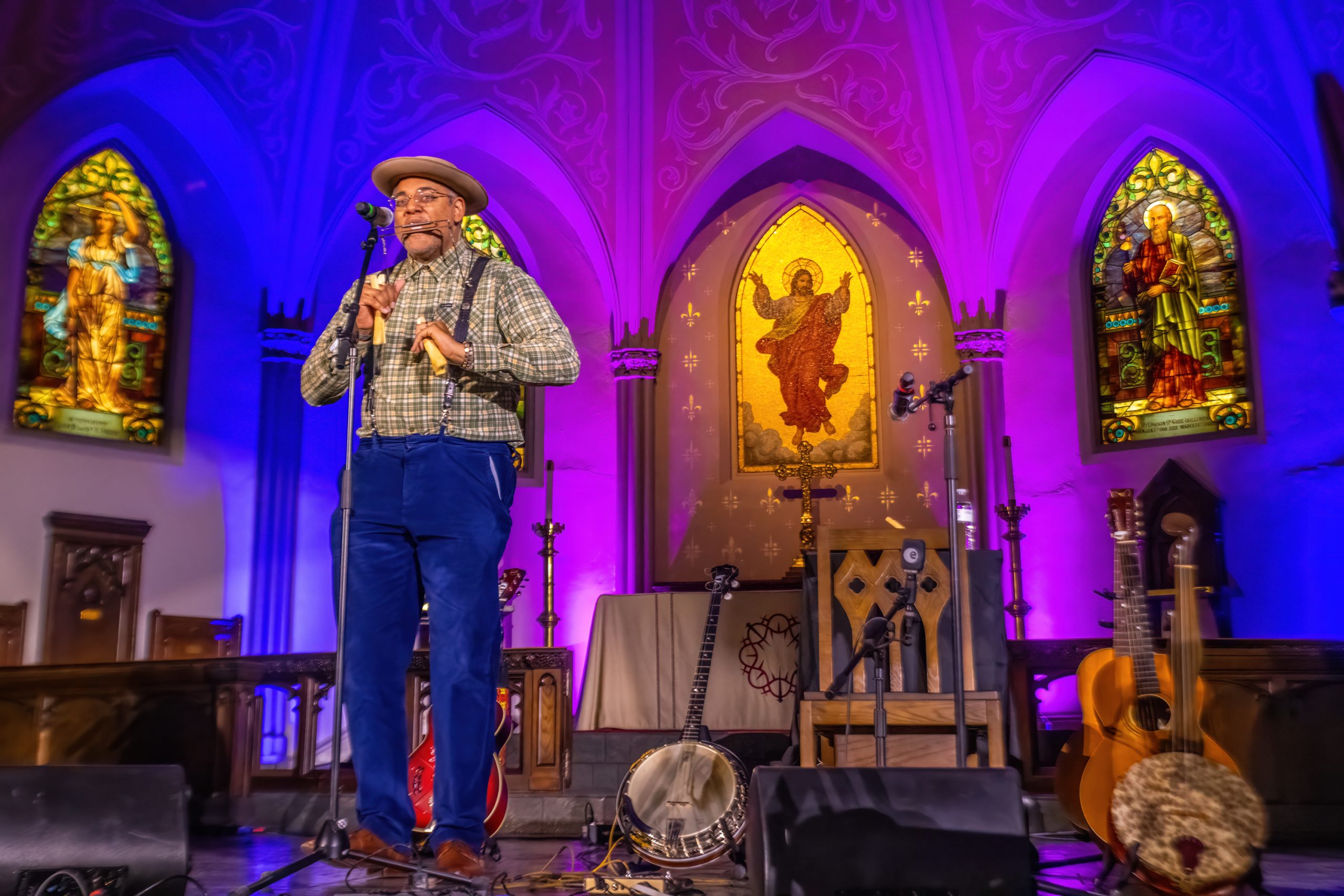
The segue from Real World™ to Big Ears ]can sometimes be clunky, interrupted in fits and starts by the familiar and ordinary. As I chose my seat at St. John’s Cathedral, I started to get an inkling that this was a rather direct path from one realm to the next. The quartet of guitarists that make up Dither took the stage as golden-hour sunlight washed through the west-facing stained glass. The lights in the dome above the altar were lowered and then bathed in soft purples and blues as Dither began playing the algorithmic arrangements of electronic music pioneer Laurie Spiegel.
After two pieces that were surprisingly groovy considering they were composed in part by a roomful of computers in 1980, Dither introduced their third selection as “Harmonices Mundi,” a work commissioned by Carl Sagan and NASA and shot into space as part of the gold record on the Voyager spacecraft. Originally brainstormed by Johannes Kepler in 1619, the movement is a series of drones and sirens that ebb and flow, mimicking the path of the planets around our sun. As I listened to what might very well be the first human media consumed by extraterrestrials, the last cobwebs of my day-to-day escaped my mind. Good riddance. – Daniel Britt
Turning Jewels Into Water
As a 44-year-old native Knoxvillian, there is something poignant about stepping inside of a local room for the first time. My Thursday began in The Greyhound, a historic art-deco building on Magnolia Avenue – closed for the last few years, poised for major renovation but still retaining its withered yet original midcentury charm – that was temporarily repurposed for this year’s festival. Although SML’s three-night residency at the venue necessitated a centrally located stage, this electronic duo’s propulsive fare lent itself well to an in-the-round setup, as well.
The pair’s “folk music from nowhere,” deemed as such because of its wide-ranging and inclusive nature by drummer Ravish Momin at the halfway point of the performance following an engrossing, uninterrupted 30-minute composition, fused the musical traditions of myriad cultures into an unpredictable swirling dervish. Vocal samples, preprogrammed instrumental pieces and live layered effects and percussion melded into an aural smorgasbord, satisfying an audience that was more than willing to succumb to the group’s invitation to dance if the feeling was there. – Matt Rankin
Terry Allen: Truckload of Art
At the age of 82, Lubbock, Texas,-raised singer-songwriter, playwright, visual artist (and whatever else he puts his mind to) is an inspiration. For years he has been a secret-handshake sort of an artist. If you knew him, you loved him. Now a Big Ears veteran, this first of his three sets at the festival featured music by Allen and writer/singer/songwriter/actress Jo Harvey Allen, intermixed with terrific family stories about the songs they would then perform with an abbreviated version of the Panhandle Mystery Band. It also featured a talk and reading by Brendan Greaves, who recently authored the authorized biography of Allen (a presentation good enough to convince you to buy a copy of the book), and was followed by an insightful panel discussion moderated by writer and music producer Tamara Saviano.
Both Terry and Jo Harvey proved to be personable storytellers, and the small venue The Blackbox was a great intimate space for this iteration of the Allen’s work. Terry’s songs are modest marvels. Delivered in an infectious Texas drawl, the songs are deeper and more profound than the generally simple melodies would suggest. Friday’s performances at the Civic Auditorium promise to be more conceptual visually with the same heart and talent. I may not forgive myself if I miss it. – WB
Mali Obomsawin (Deerlady)
I started my Big Ears adventure a little later in the evening than I had initially anticipated, so I was in scramble mode to make sure my first show would be a worthy one. I found Deerlady at PostModern Sound Exchange, a new venue located on Jackson Avenue near Jackson Terminal. In addition to performances, PostModern will serve as a four-day record fair, hosting artist panels and discussions throughout the weekend, all free to the public.
As for Deerlady’s performance, renowned bassist Mali Obomsawin, who is normally part of a duo with guitarist Magdalena Abrego, was joined by a full band for this intimate performance. The group put on a clinic in experimental post-punk to the delight of the packed-out venue. Their show went much harder than what I had heard previously, as they blended harmonies with a raw neo-goth sound, somewhat like an edgier Lucius. Needless to say, Deerlady’s show set the right tone for my first evening. – John Flannagan
Natalie Bergman
The psych-pop purveyor could be forgiven for confusing the home of Big Ears for Music City given the willingness of the sizable Barley’s crowd to indulge her in a couple of coordinated line dances, and the momentary slight cringe certainly could not overshadow Bergman and her ace band’s command of the Old City taproom. Starting out with a few slow but steady numbers, the group exhibited greater confidence and control as it played on, culminating in a triplicate of truly extraordinary songs to end the set. There were similarities to Jessica Pratt’s performance at the Tennessee last year, but this was livelier, quite a bit punchier and more cosmic country than Laurel Canyon psych folk. – MR
Sam Amidon
This Vermont-born modern folk hero has made multiple appearances at Big Ears. And while on the surface it could be assumed the act could seem repetitive, I can assure you that Amidon, with collaborators in tow, has never played the same set twice. A master of the mandolin, violin and banjo, Amidon has truly embraced the spirit of this festival, reworking old tunes into something completely different along with introducing new favorites.
The artist has incorporated elements of jazz, rock and even electronic sounds to shape songs that sound like a completely new genre. His well-known tunes “Prodigal Son” and “Oh Where” carried elements of the somber and sorrowful atmosphere that flavors his body of work, with achingly melancholy violin wails and haunting banjo notes. However, the songs took turns into experimental time signatures, awkward runs and purposefully jarring notes. His transition from “Oh Where” to “As I Roved Out” was especially telling of this experimentation, melting his lonely mandolin into driving drums and shouts, turning the energy all the way up.
His collaborative efforts were also quite a treat, as he encouraged multiple audience-participation pieces and even included Joe Westerlund and John Dietrich of Deerhoof, who had just finished their set at Mill & Mine the hour prior. All this to say: If you see Amidon on the schedule and think of skipping because you think you’ve seen him before, I can assure you that you have not. The man truly embraces the creative spirit, ever evolving and growing in his art. – JDR
Bloodshot Bill
SML
SML at The Greyhound was a must-see on opening night for me due to one simple factor: curiosity. The new venue, a bus station I had walked past hundreds of times but had never been inside, was certainly a draw for me, as was the improvisational aspect of SML’s shows. The stage in the Greyhound is set in the center of the gutted terminal with the crowd creating a ring around the artists, heightening the air of populism that is already apparent in jazz.
The show started in a cacophony, with Josh Johnson’s horn creating a violent foil for the rumbles and hums of the bass and synth. The lights for the show, projected from wall to wall, would seemingly bounce at you from every corner, adding to the effect of the musical outbursts. Settling into a rhythm, the brass engaged the crowd with some downright melodic accompaniments and created a general sway and togetherness within the inner ring of listeners. Once they had the audience, they did not let go, keeping a high pace and energy for the duration. My curiosity satisfied, the next visit to a show during SML’s three-night residency will be for an altogether different reason: appreciation. – DB
Tunde Adebimpe
Tunde Adebimpe, who is best known as the founder of the acclaimed indie-rock outfit TV on the Radio, released his first solo album, “Thee Black Boltz,” last spring. Adebimpe walked out onto the stage with only a boombox, then loaded a cassette containing all of his beats and songs from his terrific solo debut. His voice was in vintage form, hitting his trademark high notes with perfection. The preprogrammed beats coupled with the sound mix at the Mill & Mine were a fantastic match, as Adebimpe flowed through his brief 45-minute set.
As he stopped midway to talk about his inspiration for the album, he told a story of his post-pandemic depression, losing his sister and contemplating not even making music any longer. Luckily for everyone, the renowned label Sub-Pop stepped up and released his music, and the rest is history. After seeing his songs live for the first time and hearing the backstory of how the album came to be, I have a new appreciation for both. – JF
Taper’s Choice
How exactly does one warmly and accurately describe a thorough face-melting of this magnitude? And how is it possible that the abbreviated opening night of this year’s fest laid claim to such an indelible performance amongst so many others? If this was, in fact, Dave Harrington’s last appearance with the jammy supergroup (as it appears his amicable departure is imminent), then he went out with one hell of a bang late Thursday at Jackson Terminal.
The lead guitarist’s forays were numerous and momentous, but the band as a whole was immense on the night. Fusing the spirit of the Grateful Dead with the musicality of MMJ, Pink Floyd and King Gizzard & the Lizard Wizard (among several other touchstones), Taper’s Choice enthralled for the duration of its allotted time and then some, exiting to raucous cheers after taking multiple bows and instigating immediate discussion as to what the next incarnation of the band may look like. – MR
Jesse Harris Cosmo
A John Zorn acolyte, Harris led a band that included four other magnificent players on a journey exploring surprisingly melodic and instantly appealing … Americana? … late night Thursday at Barley’s. Sometimes patient and meandering but often spiky and almost gothic, the group touched upon “difficult listening” from time to time but never failed to return to a more comfortable stasis. On at least a couple of occasions, the transition was so good that I started to laugh; positioned along the wooden railing surrounding the stage, I was in close proximity to the musicians, and the bassist, noticing my reactions, chuckled each time. Such synchronicity defines Big Ears, a festival that obliterates the standard aperture between artist and fan. – MR