Speaking with Summer G. Awad, playwright of ‘WALLS: A Play for Palestine’
By Harrison Young
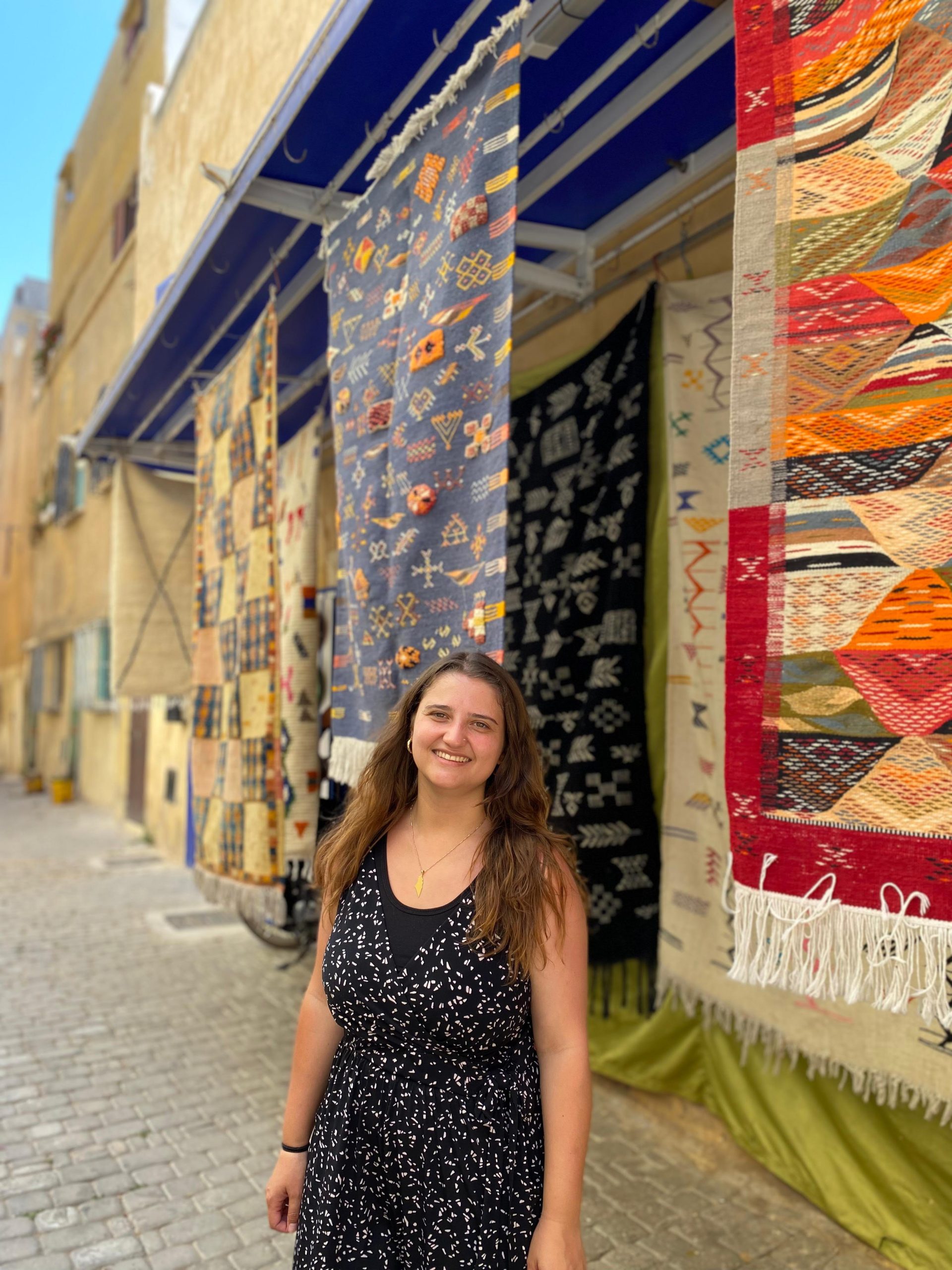
Summer G. Awad is a playwright, speculative fiction writer, actress and slam poet with an eye for energy and sincerity. I first worked with Awad in 2020 when she acted for a virtual reading I produced of “The Wheel Woman” as part of the Seattle edition of the Dramatists Guild’s Footlights City Swap. We first met around 2016, though, which was also around the time she created “WALLS: A Play for Palestine,” a story that quickly made it to the New York International Fringe Festival. This was just one of the reasons why she was later honored by the East Tennessee Writers Hall of Fame with their Emerging Writer Award – an award that pairs nicely with the writing trophies she earned in the first and second grades. Most recently, she’s writing nonfiction essays about her experience with refugees who resettle in Tennessee.
Here’s how our interview went.
BLANK Newspaper: Who is a playwright that inspired your writing style?
Summer G. Awad: The first time I ever thought of being a playwright was after acting in “The Vagina Monologues,” put on by the Women’s Coordinating Council at UT. I felt like that monologue format helped me reimagine what a play could look like. I knew it didn’t have to be just scenes of straight dialogue but could incorporate more storytelling and poetry. That’s exactly the direction I went with “WALLS.”
BN: What was your first victory as a playwright?
SGA: Giving up on trying to tell other people’s stories and telling my own instead. “Write what you know” is cliched writing advice, but for good reason. I started writing “WALLS” based on interviews with Palestinian refugees and tried to invent characters, but when I decided the main characters would be versions of myself and my own father, all the pieces fell into place.
BN: Your poetry and playwriting have spoken confidently on hot topics in society. For anybody wondering how to get more confidence to speak up in the creative arts, what would you offer?
SGA: Do a lot of research, and be open to feedback and criticism. Make sure that the topics you’re writing about are read by those with lived experiences before putting them out there. Give yourself and others grace. There are a lot of things I wrote in “WALLS” that I would write differently now that I have a deeper understanding of the issues in it. But “WALLS” also came about in a particular moment in my own exploration of my identity and in the Palestine liberation movement, and I think still there’s a place for it. I also strongly believe that every play on a social justice topic should have a talkback – not just one focused on playwright and actor process, but also that features experts on whatever topic is being discussed.
Plays are such a great way to open up social issues from a more accessible angle, but it’s important to provide audience members with a way to process through what they watched, connect it to the real world and have a way to tangibly engage with the issue when they leave. One of the things I’m most proud of about “WALLS” is that we created a hybrid program and resource booklet so that people left with key terms and a list of further readings about the Palestinian struggle.
BN: “WALLS” is about a Palestinian teenager working through complex relationships and balancing her ties with her traditional Muslim father and East Tennessee history. It was first produced in January 2016 in Knoxville, with its most recent performance being a stage reading in Iowa in November 2023 – a very different time and context. How have you evolved since its original creation?
SGA: Both my own relationship to my Palestinian identity and the Palestinian liberation movement have changed so much in the 10 years since I wrote this play. I’ve also just grown up a lot. Since the premiere, I’ve traveled to Palestine again on a structured delegation with Eyewitness Palestine about environmental justice and the olive harvest. I am so grateful for that trip and all the people that contributed to my fundraising for it. It allowed me to see firsthand a lot of the things I’ve been studying about for so long and inspired more poetry that I’ve since published.
BN: You not only produced “WALLS” over Zoom during the pandemic, but you also acted online during this timeframe, too. Five years later, how do you reflect back on how the pandemic affected the performing arts?
SGA: I was on the board of Flying Anvil Theatre during the pandemic, and so I had to be a part of the difficult decision to close down the theater. That was really disappointing because I felt like Flying Anvil was one of very few theaters in the Knoxville area doing the kind of social justice-centered theater that I wanted to be a part of. Although Flying Anvil did some virtual shows and put on the COVID Stories Project to try to process through some of that experience as a community, it ultimately wasn’t enough to come back from the financial losses suffered from the inability to do in-person theater for so long. Running a theater is such a balance between wanting to push the boundaries and also needing ticket sales from more traditional shows. I hope something similar will pop up in its place someday.
BN: Your education includes a BA in literary activism and an MFA in creative writing and environment. What would you recommend to someone wanting to follow your educational path?
SGA: You can be a writer with any kind of degree. You can be a writer with or without an MFA. It just all depends on your personal workflow and motivations and what you feel like you need to achieve your goals. With that being said, I’m really glad I chose interdisciplinary programs for both my undergraduate degree and MFA. I think writers are often siloed off from the “real world,” and so I was grateful to get to learn all kinds of things about the world while also learning how to write. If you do an MFA, don’t go into debt to do it; there are lots of fully funded programs. Don’t expect that an MFA will lead to a publishing contract. It gives you the time and space to write, but you have to do the work on your end to find agents, enter contests and ultimately get the finished product to a publisher when you’re done. I’m a year and a half out of my MFA, and I’m still not there yet.
For more information about Summer G. Awad’s work, visit https://summerawad.com.