By William Wright
The gravitational center of my life is music, and because of that, music rarely surprises me anymore. I’ve trained myself to hear it on the molecular level, but from a distance – stripped of novelty, style or sentiment, until it becomes something structural and informational. It has made me good at what I do and mostly immune to being moved by it. Film has never offered me that kind of immunity.
In 2025, I was still 100% cinema’s bitch. Most movies get under my skin with alarming ease, and I want them to. Filmmaking still scares me, breaks my heart, makes me angry, delights me and embarrasses me into laughter. It was the reason I gravitated toward film scoring in this second chapter of my career, and it was the reason I was so excited to lean harder into writing about movies in 2025, a year that felt unusually ripe with films willing to take risks – formally, emotionally or both.
What follows are the 10 that held me the tightest, and a bit about why for each.
10. “Realm of Satan” is the rare documentary that understands how much power there is in refusing to explain itself. Scott Cummings doesn’t argue for Satanism, doesn’t contextualize it for nervous outsiders and doesn’t try to rescue it from its own reputation. Instead, he simply observes, often without dialogue and at extreme physical distance. He builds meaning through accumulation, through rhythm, through a series of images that are strange until they aren’t: a goat giving birth; a woman breastfeeding it; sheets drying on a line; leaders of the Church mixing cocktails in a room that looks more like a lovingly curated thrift store than a temple. By the time the film has settled into its own peculiar cadence, the supposedly transgressive elements have become mundane, and that is the point. Cummings normalizes without defanging, finding humor, warmth and even tenderness in a community that has spent decades being flattened into caricature. It is formally playful, quietly political and often very funny.
9. “KPop Demon Hunters” is the kind of movie that critics are supposed to resist and that culture sometimes demands we surrender to. I see no reason to even try applying much analytical language to this one. There’s something about a film (or band, or story) saturating the world, even for a short time, that feels special and connective. The fact that this film was cast off to Netflix because of COVID gives it just enough underdog edge to sweeten all of the hysteria. Yes, it borrows liberally from familiar emotional beats – self-acceptance, hidden identity, chosen family – but it executes them with such clarity and energy that the familiarity becomes a feature rather than a flaw. This is pop filmmaking doing exactly what pop is supposed to do: sneaking emotional coherence and formal ambition into something that feels effortless, contagious and fun.
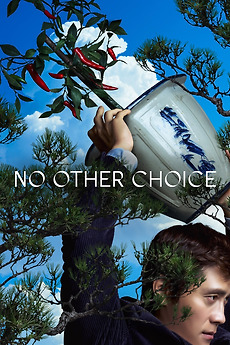
8. “No Other Choice” is Park Chan-wook reminding us that comedy might be his most vicious weapon. This unpacking of the AI crisis descending on global industries didn’t have to be a knee-slapper, but here we are. Luckily, it is also one of the most unsettling portraits of contemporary anxiety I’ve seen in years, a thriller without a villain that nonetheless feels constantly under siege. Lee Byung-hun of “Squid Game” fame carries us through, playing an unemployed father whose determination to right his family’s situation is slowly weaponized against himself. He is sympathetic, frightening, ridiculous and painfully recognizable all at once.
7. “Weapons” is the movie that confirmed Zach Cregger is not a fluke. What impresses most is neither its cruelty (which is considerable) nor its humor (which is genuinely nasty) but instead its unity. Whereas “Barbarian” felt like a thrilling series of left turns, “Weapons” feels like a single sustained nightmare that knows exactly what it’s doing, even when we (often) don’t. The jumpy structure is tricky without feeling gimmicky, and the film’s escalating dread feels meticulously choreographed rather than dumped on the audience in shocks. Yes, there is one ridiculous and unnecessary animation that should not exist, and everyone agrees on that, but it barely registers against how effectively the film uses genre to process a very American kind of horror. This is a movie that understands spectacle as a delivery system for grief, fear and rage. Couple that with some of the best editing and cinematography of the year, and it feels almost silly to lump this in with the term ‘genre film.’
6. “Nouvelle Vague” may or may not be a good movie, but it taught me that it’s OK not to worry about that. Richard Linklater’s affection for the French New Wave is so naked and so indulgent that resistance feels pointless. The choice to fully commit to the textures and limitations of the era is not subtle, but it is sincere and effortlessly cool in a way that carries a lot of weight with me. Sometimes vibes are enough. Linklater’s portraiture of the who’s who of the French New Wave is particularly charming and, in moments, brushes up against Wes Anderson territory. But it stays focused on what we came for: Godard being annoying and cool while changing cinema forever.
5. “On Becoming a Guinea Fowl” unfolds with a patience that feels almost radical. The opening stretch alone is so assured, quiet and internal that it recalibrated my expectations for everything that followed. Rungano Nyoni has an extraordinary command of withholding, letting meaning surface slowly, painfully and without relief. Every performance feels lived in, every silence earned. The film’s exploration of family, repression and survival never tips into instruction or catharsis. Instead, it asks the audience to sit with discomfort and decide what to do with it. The visual language blurs reality and perception just enough to mirror the experience of its characters, and the result is a film that feels both intimate and vast. It is restraint as a moral choice, and it is a revelation because of it, with one of the most chilling terminating beats of the year.
4. Guillermo del Toro’s “Frankenstein” gave me almost everything I hoped it would. It is lush, mournful, romantic and deeply invested in the language of Shelley’s text, especially the monologues that so many adaptations flatten or discard. This film understands the source material as a story about longing and inheritance as much as monstrosity, and it stages those ideas with operatic care. The production design is (predictably) astonishing, anchored by one of the great gothic towers, and the creature’s design, while stylized, never collapses under the weight of reinvention (looking at you, “It”). Jacob Elordi navigates an incredibly difficult role with surprising grace, and Mia Goth is finally allowed to do some acting worthy of her intensity. This is not a perfect film, but it is one made with such evident devotion that its imperfections are easily forgivable.
3. “One Battle After Another” feels like the movie Paul Thomas Anderson has been circling his entire career. It is ferocious, funny, terrifying and unexpectedly tender, a present-tense reckoning that refuses abstraction. Anderson has always understood America as a contradiction factory, but here he lets that contradiction detonate in real time. The action sequences are staggering, staged with a physicality that feels almost rude in its immediacy, but what stayed with me was the film’s emotional spine. Beneath the chaos is a deeply felt father-daughter story that refuses cynicism, even as it acknowledges how broken things are. This is a filmmaker watching the world burn and still insisting on care, connection and responsibility. It knocked the wind out of me.
2. “Sorry, Baby” is one of the most impressive debuts I have seen in years, not because it announces itself loudly, but because it knows exactly how much weight it can carry. Eva Victor writes, directs and stars with a confidence that never hardens into bravado. The film is funny, brutally so at times, and then quietly devastating in ways that feel almost rude in their accuracy. What it captures so well is not just trauma, but the institutional and social failures that surround it: the banal cruelties of systems that claim sympathy while offering nothing useful. Victor’s control of tone is extraordinary, allowing humor and horror to coexist without canceling each other out. This is a film that understands how deeply f***ed up ordinary life can be, and it says so without flinching.
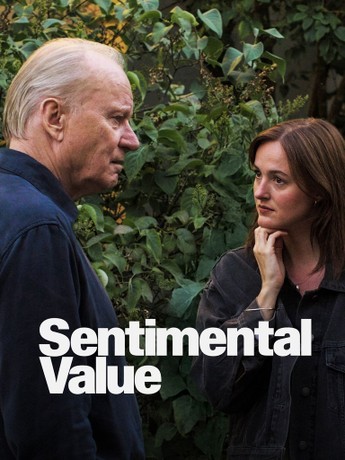
1. “Sentimental Value” felt unfairly tailored to me, and I am comfortable admitting that. Joachim Trier’s film moves with such quiet confidence and such lyrical restraint that it never once feels the need to raise its voice. Inhabiting a man shaped by art, regret and distance with devastating precision, Stellan Skarsgård has rarely been better. The film traces the fractures of a family, the tension between stage and screen, past and present, with a gentleness that makes its emotional weight feel cumulative rather than crushing. The craft is immaculate but self-effacing, giving a talky, interior story momentum without spectacle. In a year where so many films processed trauma by dragging us through it, “Sentimental Value” chose to sit with it, listen to it and quietly suggest the possibility of a cold and broken kind of repair.