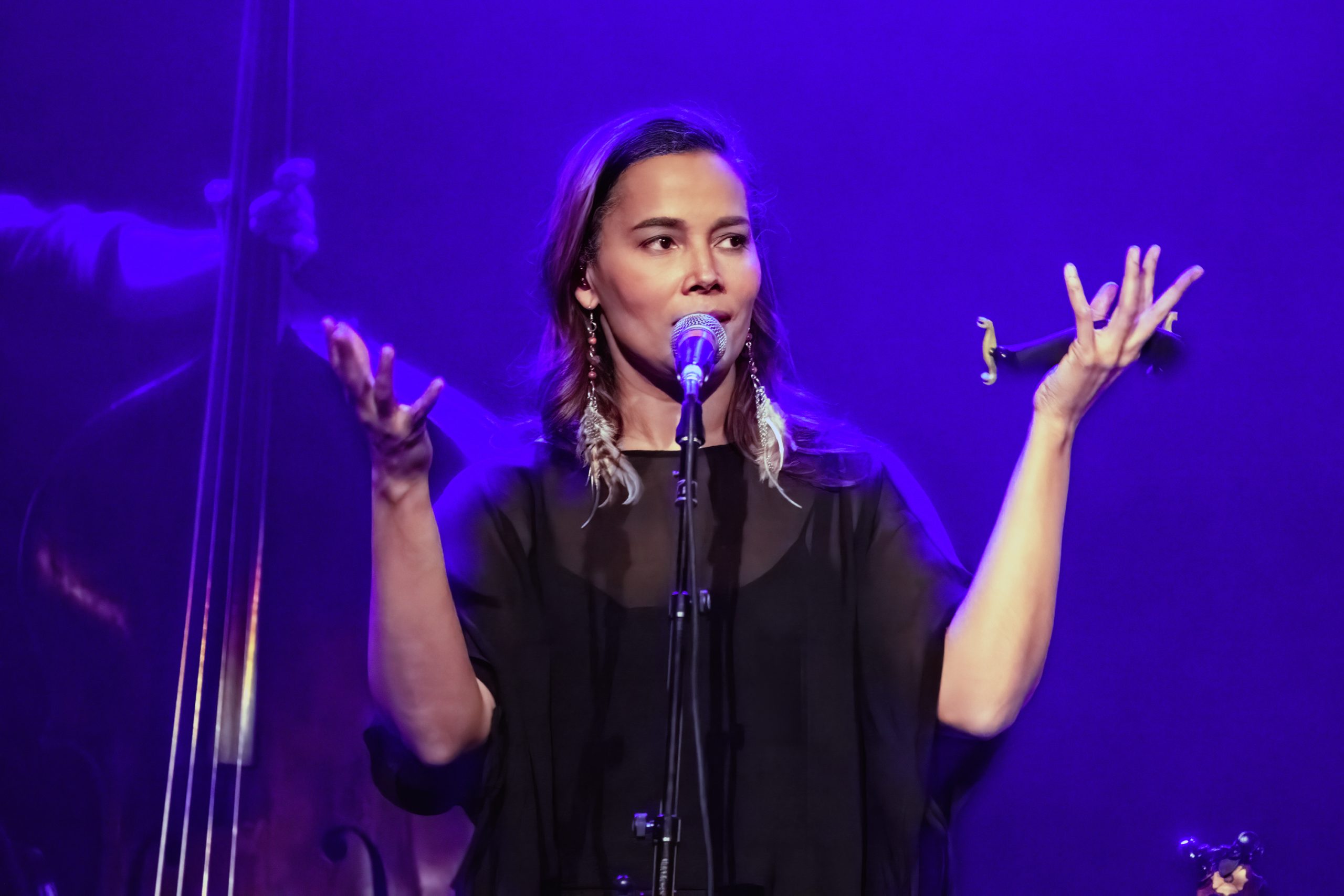
Hurray for the Riff Raff

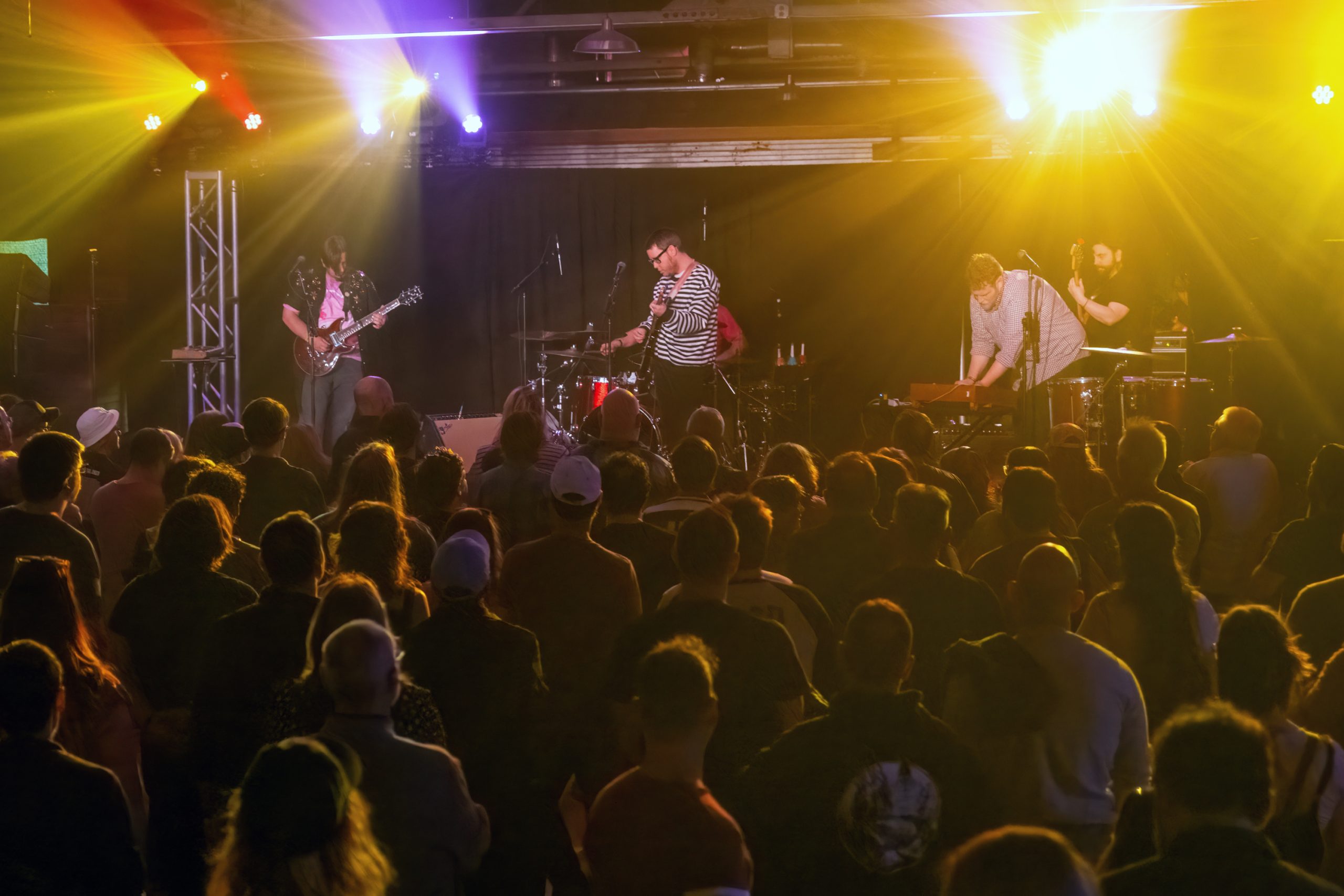
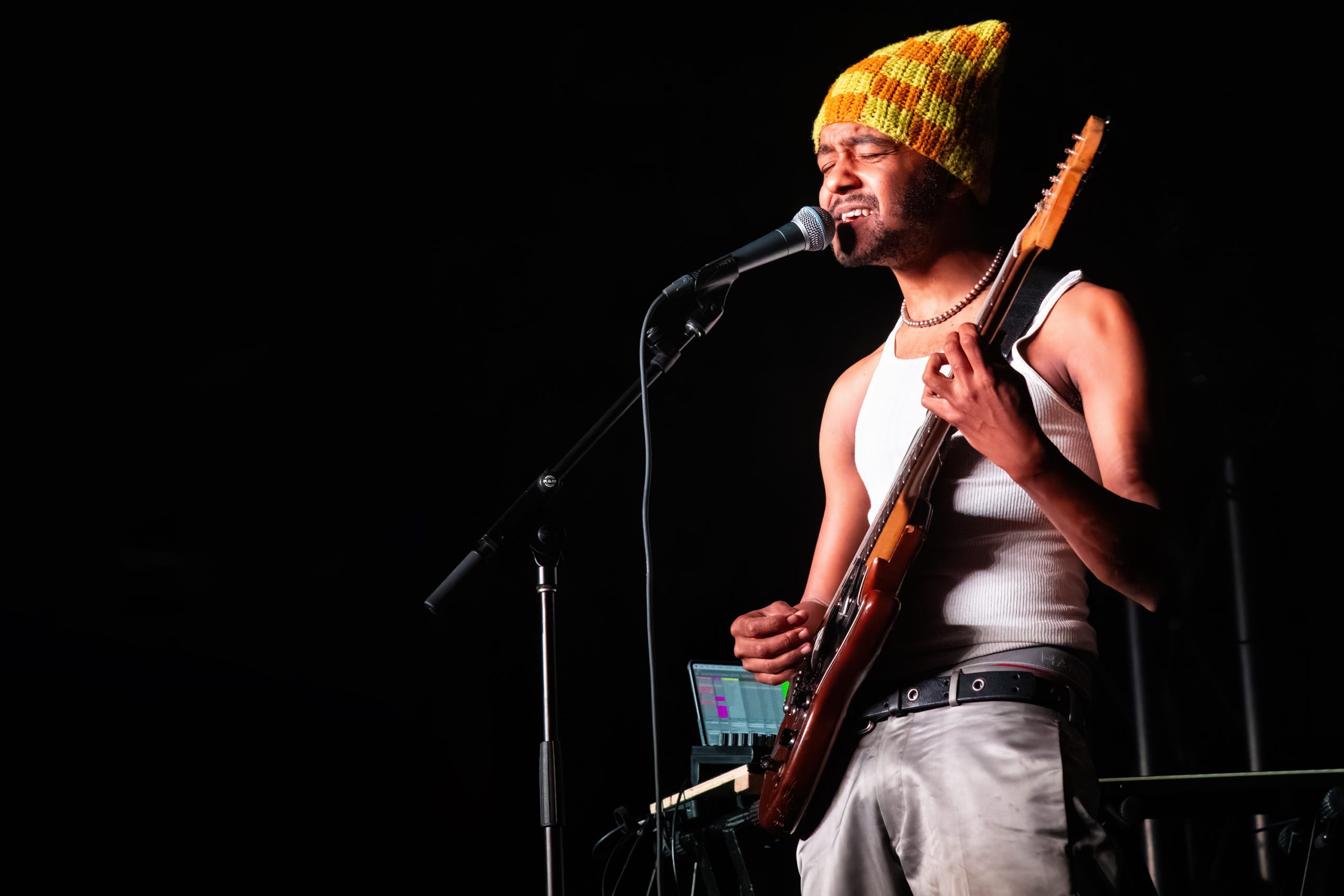
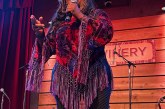
The drummer’s placement at stage left at the Mill & Mine allowed Alynda Segarra and their accompanying guitarist and bassist to form intimate, triangulating patterns from the center to the right of the platform with frequency, the concentration of the stringed instruments alternately producing lilting country rock and a maelstrom of cascading rhythms – though oftentimes within the course of the same track. While the frontperson’s confessional vocals were strong, immediate and arresting, they were still imbued with a softness that lent the earnest lyricism an affecting quality.
Although the group’s most recent material sounded best in the early afternoon, it was the 2014 hit “The Body Electric” that perhaps unsurprisingly drew the most cheers. In an unusual-for-Big Ears issue that strangely persisted throughout the day, the band wrapped up its set a quarter of an hour short of its allotted time. Normally, such a deprivation might incite a grumble or two, but on a weekend so jam-packed with options and conflicts, nary a peep of dissension could be heard from the sizable crowd – impressive at that early hour – which dispersed quickly and at varying exit angles. – Matt Rankin
claire rousay
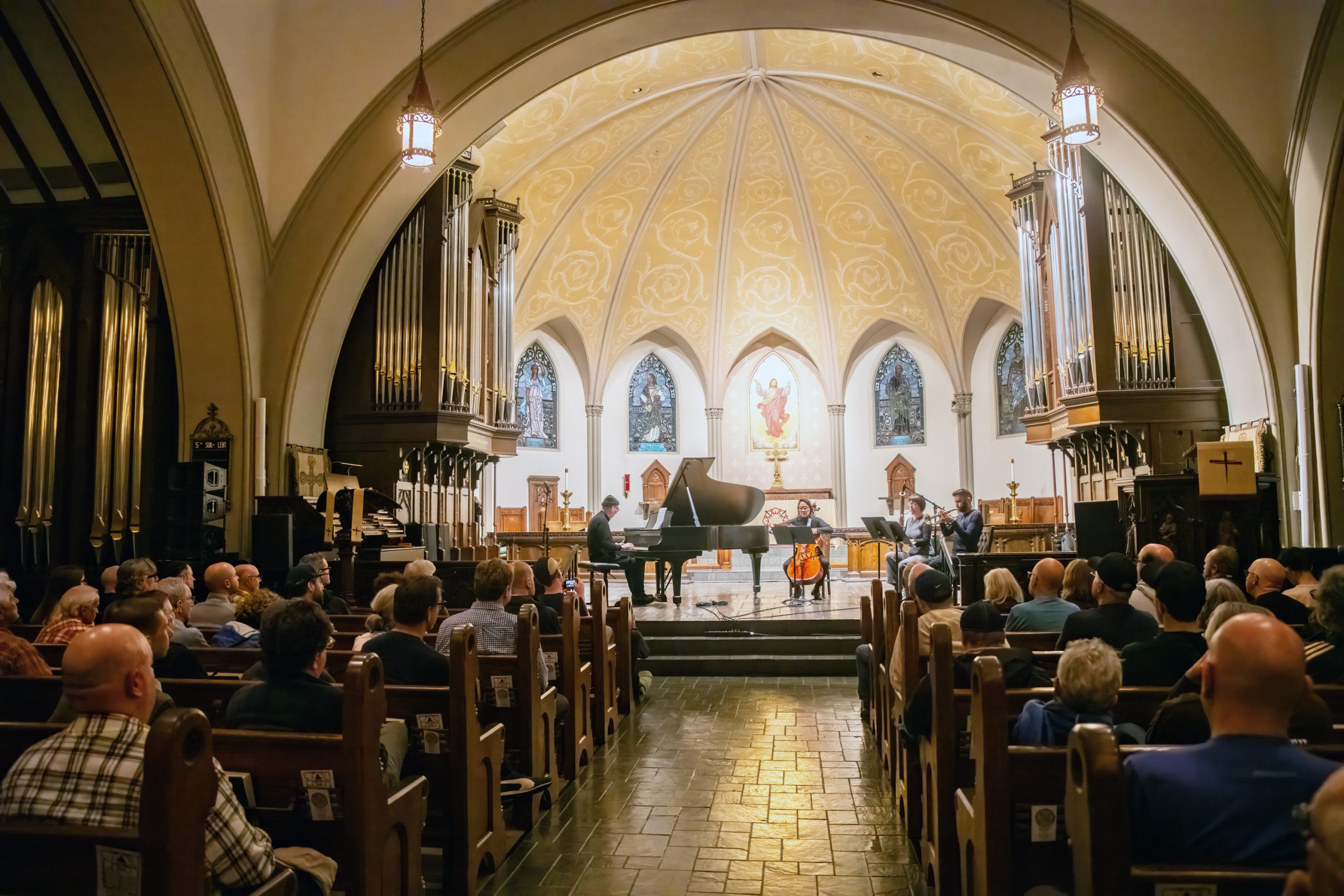
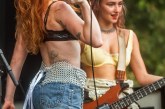
If nothing else, the prolific Canadian-American composer conjured a definite vibe with her Friday set at The Point. That the material presented to a capacity crowd at the historic church building greatly differed from her experimental, largely instrumental recorded output thus far was unexpected but welcome; that the performance art on display was so thoroughly and unapologetically emo – for a lack of a better descriptor – was rather surprising, but it produced an engrossing spectacle.
The venue’s modest stage was set up to accommodate an actual bedroom scene, replete with corner walls, a made air-mattress bed, a nightstand, a desk lamp and (from my vantage point) at least one bawdy poster. Despite the ornateness, it conveyed an emotional contiguity to adolescence that helped shape the contours of the set. Clad mainly in black, ambling awkwardly about the stage and sometimes standing with her back facing the audience, rousay looked the part of a disaffected youth as she sang through a mic that filtered her voice into a gender-neutral monotone.
She sporadically brandished an electric guitar, the tones of which fluttered beautifully before affixing to the warm drones, bass tones and synth baths produced by her onstage partner. The combination of dulcet electronic eddies and raw lyricality was magnetic, but rousay threatened to derail the proceedings when, after 10 minutes or so, she hopped off the stage, strode down an aisle and exited the sanctuary. Although the music continued in her absence, the move was confusing and jarring for those in attendance. However, she reappeared, sans oversized sweatshirt, after a few minutes and recommenced the performance as if nothing peculiar had happened.
According to the venue’s stage manager, with whom I spoke later in the evening, rousay had left to enjoy a smoke outside in the hazy sunshine, pausing to acknowledge and even pose in photos with queued fans who recognized her striking visage while waiting patiently for entry. (Unbeknownst to him in advance of the performance, her representatives assured him when it happened that the stunt is something she often pulls during her shows.) This was a most unusual yet richly rewarding and quintessentially Big Ears-y set where it was least expected. – MR
Editor’s note: This wonderful recap of the weekend written by Eric Dawson (a regular contributor to BLANK) for Arts Knoxville includes a segment on rousay in which he provides greater clarification about her foray outdoors. As was revealed in her Ableton session the next day, she primarily used the interruption to record found sounds, which she then incorporated into the performance.
Molly Tuttle & Golden Highway
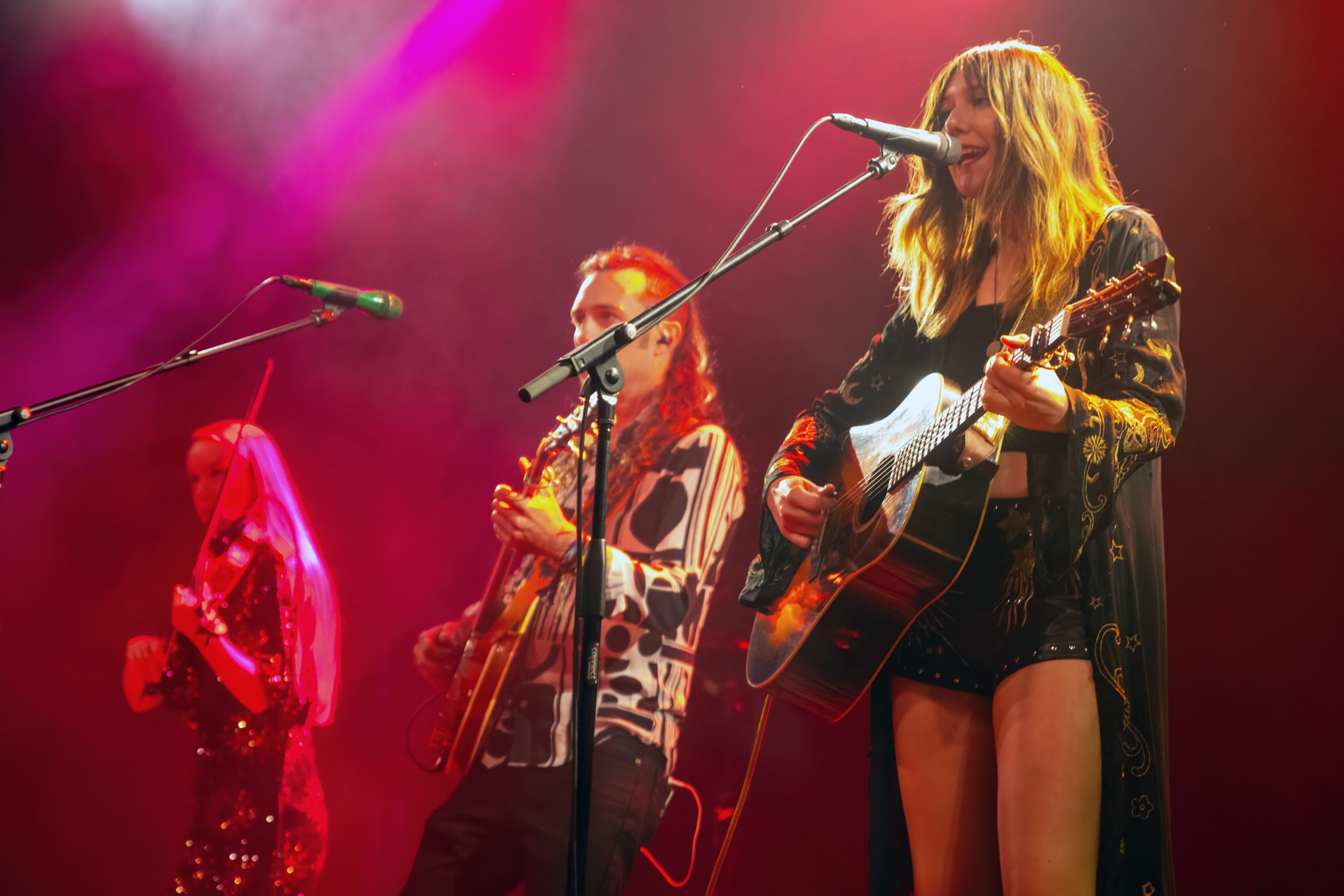
There was a stretch of time Friday that provided a proverbial cleansing of the palate for Big Ears attendees who either already had been worn out by concentrating too long and hard on the esoteric or who were OK but needed a refresh in advance of what was yet to come. The trifecta of Sam Amidon, Mighty Poplar and Molly Tuttle and company provided a soothing soundtrack during the mid-to-late afternoon hours, offering familiar-sounding but enhanced, enlightened and highly proficient takes on more customary music styles than what is the norm at this festival.
Tuttle’s strain of California bluegrass is an absolute delight, reveling in the history of the form but determined to forge a progressive path forward – both musically and thematically. And, as was mentioned to me several times since the set concluded, her band consists of supremely talented individuals who just so happen to also sound great as a cohesive unit. From sprightly covers, like an inspired “White Rabbit” that showcased the bandleader’s vocal range, to the multitude of superb originals, nothing was beyond the group’s technical abilities or expressive capabilities. -MR
Senryu
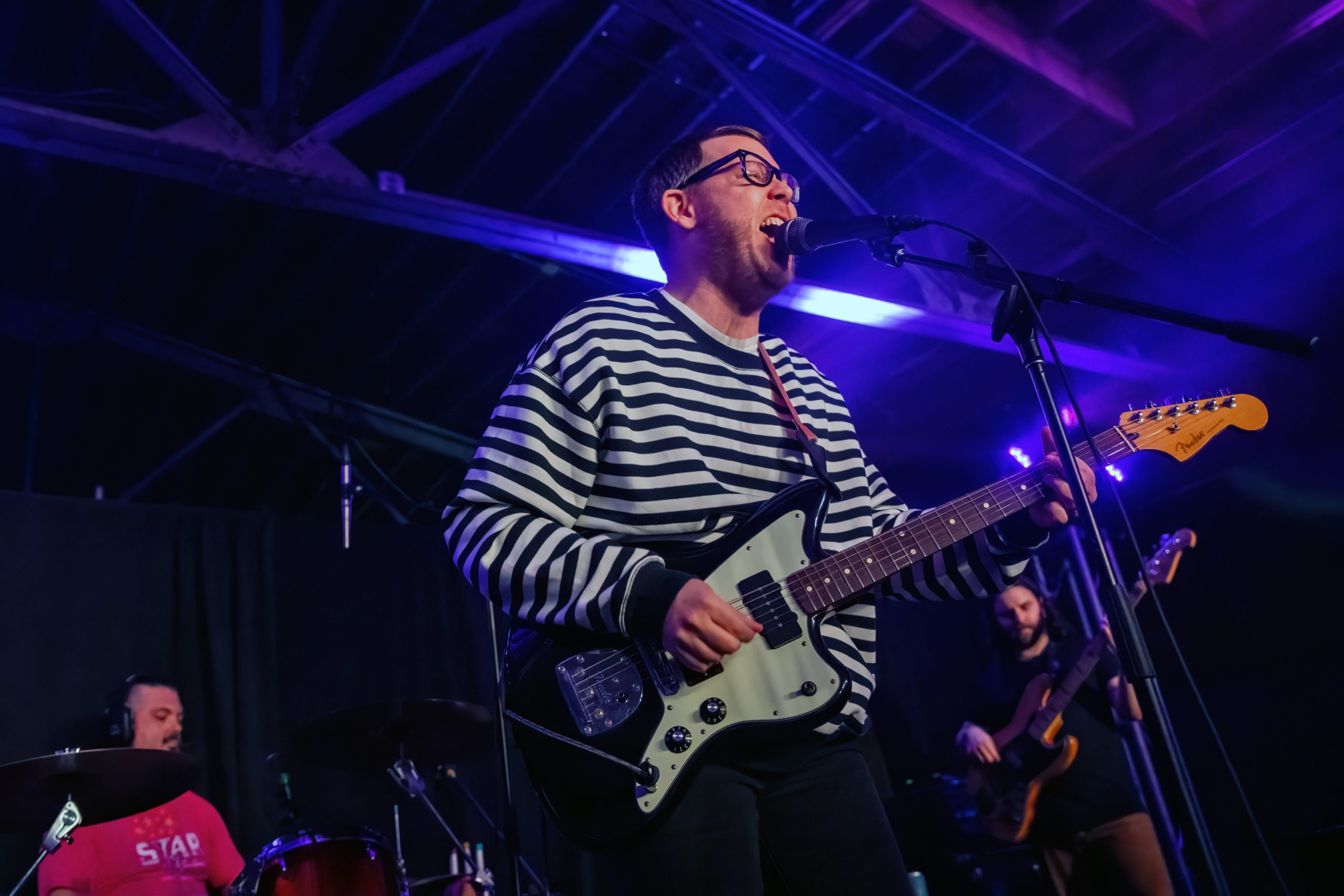
Anyone who has ever seen Knoxville band Senryu knows they always deserved a slot at Big Ears. Late Friday afternoon, the band finally got the chance to show the world why. It’s art rock that is easy to love – an aural equivalent of a combination of Edward Hopper and Salvador Dali. It’s familiar and lovable, but it’s a little out there, as well. With nearly a quarter of a century’s worth of music from which to draw, the five-piece group delivered a cross-section of at least their last decade’s best songs, from the straight-up rabble rousers “I Am a Battering Ram” and “Hometown Bounce” to the more meditative “Summer Death March” and, finally, the emotional “Great. Expectations.” with its chorus of “Were you expecting the end of the world?”
Everything was in place for the Big Ears show: lead singer/guitarist Wil Wright guiding the emotional arc; Steven Rodgers handing over the drum kit to bassist Andres McCormack in order to smack cymbals together above his head; guitarist Dan McCormack and percussionist/bassist Zac Fallon also providing some electronic seasoning along with their other duties; and all of it combining in a group that sounds like no other.
Thank you, Big Ears, for letting Knoxville display some of its own world-class talent to the world. – Wayne Bledsoe
Brad Mehldau
Since Brad Mehldau was one of jazz music’s buzz artists in the 1990s, he’s only gotten deeper and better. In Friday’s solo piano set at the Tennessee Theatre, he exhibited all of the qualities that have made him beloved by those in the know. Although his music has plenty of its qualities, describing Mehldau’s music as jazz is actually far too limiting. There’s a heavy dose of classical (Friday he performed Gabriel Fauré’s “7th Piano Nocturne”) and elements of folk, blues and gospel.
Along with his own compositions, Mehldau took simple melodies by rock and pop artists, including Neil Young, Elliott Smith, Beck and the Beatles and explored them and expanded them. It’s what jazz artists used to do with show tunes and pop standards, and not enough modern jazz artists have done with newer songs since. One of the most endearing things about Mehldau’s style is that he doesn’t grandstand. He can wow you with his technique and ability, but he never belabors a song. He says all he needs to say, plays with a tune’s possibilities and then ends it. He puts his head low near the keyboard as he gets into a piece and seems to absorb it. Maybe the most important part is that his audience can feel how much he loves music and doesn’t discriminate between the styles. It certainly makes him a perfect fit for a festival where the audience feels the same. – WB
Laurie Anderson and Sexmob
“Performance artist” is the term typically used to describe Laurie Anderson, but that can give the impression that her work is less accessible than it is. She’s a singer, a songwriter, a violinist, a comedian, a motivational speaker and a provocateur – all in one performance. Sure, she often alters her voice to sound like a slightly threatening man and, at other times, a weird cross between a chipmunk and a child. She uses videos and electronic instruments and effects to accentuate her stories. And, on Friday, she utilized the musically nimble and adventurous quintet Sexmob to back her on her songs and other creations. But, at her core, she’s a storyteller. Without any of the cool and fun effects that she employs, she could still captivate an audience simply telling stories while sitting around a campfire.
Friday, she gave audiences a sort of cross-section of her “greatest hits,” including a rendition of her 1981 breakthrough number “O Superman.” She paid homage to the wisdom of Willie Nelson, Dolly Parton and Yoko Ono (for the latter, she had the audience scream for 10 seconds). It felt great, and Big Ears is probably the only festival where the attendees are cool enough to cheer for Yoko Ono as a true artist and not a joke. Later, Anderson delivered a powerful monologue from her excellent movie, “The Heart of a Dog,” in which she tells of rescuing her baby brothers from a frozen lake. Yet the most moving part of the show was when she played violin accompanying a vocal track of her late husband, Lou Reed, singing his song “Junior Dad,” from Reed’s critically maligned album with Metallica, “Lulu.” While Anderson and Reed never collaborated on a work while Reed was alive, this was beautiful, moving and unexpected.
In the concert’s encore, she led the audience in a tai chi exercise. Underneath all of Anderson’s work, there is always a sense of benevolence and a love of human connection. You can’t leave one her shows without feeling at least a little bit better about the world. I know that, on Friday, I certainly did. – WB
God Said Give ‘Em Drum Machines
I finally saw my first screening of a film during a Big Ears on Friday afternoon! With so much music and art and so many artist panels, it has always been difficult to find the time for one of the many fantastic films the festival offers each year.
I was not about to make that mistake again this year; being BLANK’s resident electronic-music beat reporter, “God Said Give ‘Em Drum Machines” was a must-see for me. The film, directed by Kristian R. Hill, is a fantastic exploration into the history of Detroit techno music, exploring the genre’s African American roots and the players who put it on the map while also telling the story of the music translated across the pond to places such as London and Berlin, and it focuses on the godfathers of the genre like Juan Atkins, Kevin Saunderson and Derek May.
Hill, who is a native of Detroit, worked on the film for 12 years, self-financing this love letter to his city and its music before finally debuting the film at Tribeca Film Festival in 2022. Pouring countless years and money into this project, Hill found help from David Arquette to finally get all the necessary financing to finally finish the film. This was no easy feat considering that, in 2019, 80 percent of all documentaries that premiered at Sundance were picked up as compared to none last year. Hill attributes this to the rise in streaming services and fewer people attending actual movie theaters these days.
The film is unapologetically Black and Detroit-centric and is the most thorough examination of the city’s techno scene that I have seen to date. After the film, King Britt led a Q&A discussion with Hill in which the director announced he is working on a second part that will likely feature more women who have contributed to the scene, as well as the second wave of Detroit artists such as Carl Craig, who performed later that night. The screening was a perfect start to the day, as King Britt would later head an all-out dance party at the Mill & Mine with several DJs to close out day two of the festival. – John Flannagan
What For? (three days of free music at Pilot Light)
Big Ears or Knoxville would not be what it is without the venerable Pilot Light.
While the venue is not featuring official Big Ears artists this year, you can always count on Jason Boardman and company to be a part of the party in some way, shape, form or fashion.
What For?, sponsored by Hologram Electronics and Knoxville Community Media, has brought 12-plus hours of music each of the first three days of Big Ears to the Old City, featuring everything from ambient electronic composers to straight-up post-punk. The shows are free, so stop in for a cheap beer and see some incredible music.
I stopped by mid-afternoon on Friday to check out A Certain Zone, Dakota Smith’s solo project. Smith is known for his band Sweet Years but is doing some truly creative things as a solo artist. This project showcases his voice, an amp, guitar and effects pedals. The result is layered music with live guitar shredding over various sounds. This project is similar to what Bradford Cox does with Atlas Sound in that it’s just he and the equipment with fantastic minimalistic results.
Next up was New York composer Telo Hoy, whose ambient style mesmerized those in attendance. Hoy played a continuous piece of music during his 30-minute set, which felt intimate and atmospheric, and he would easily fit onto any stage during Big Ears weekend.
The last act I caught during What For? was a power trio out of Louisville, Kentucky, called Ted Tyro. The three-piece played a blistering indie set that incorporated interesting timing throughout the majority of the group’s numbers. Outside of Senyru’s performance on Friday afternoon, Ted Tyro’s performance was one of the hardest and loudest sets of the day that we saw. This is a group to keep an eye on, and hopefully they’ll grace the Pilot Light stage again in the future. – JF
King Britt, DJ Heather, Suzi Analogue and Carl Craig

King Britt is becoming a fixture during Big Ears weekend, leading his Blacktronika panel discussions with various electronic performers throughout the weekend; participating in Q&A sessions after related films; and performing during the festival.
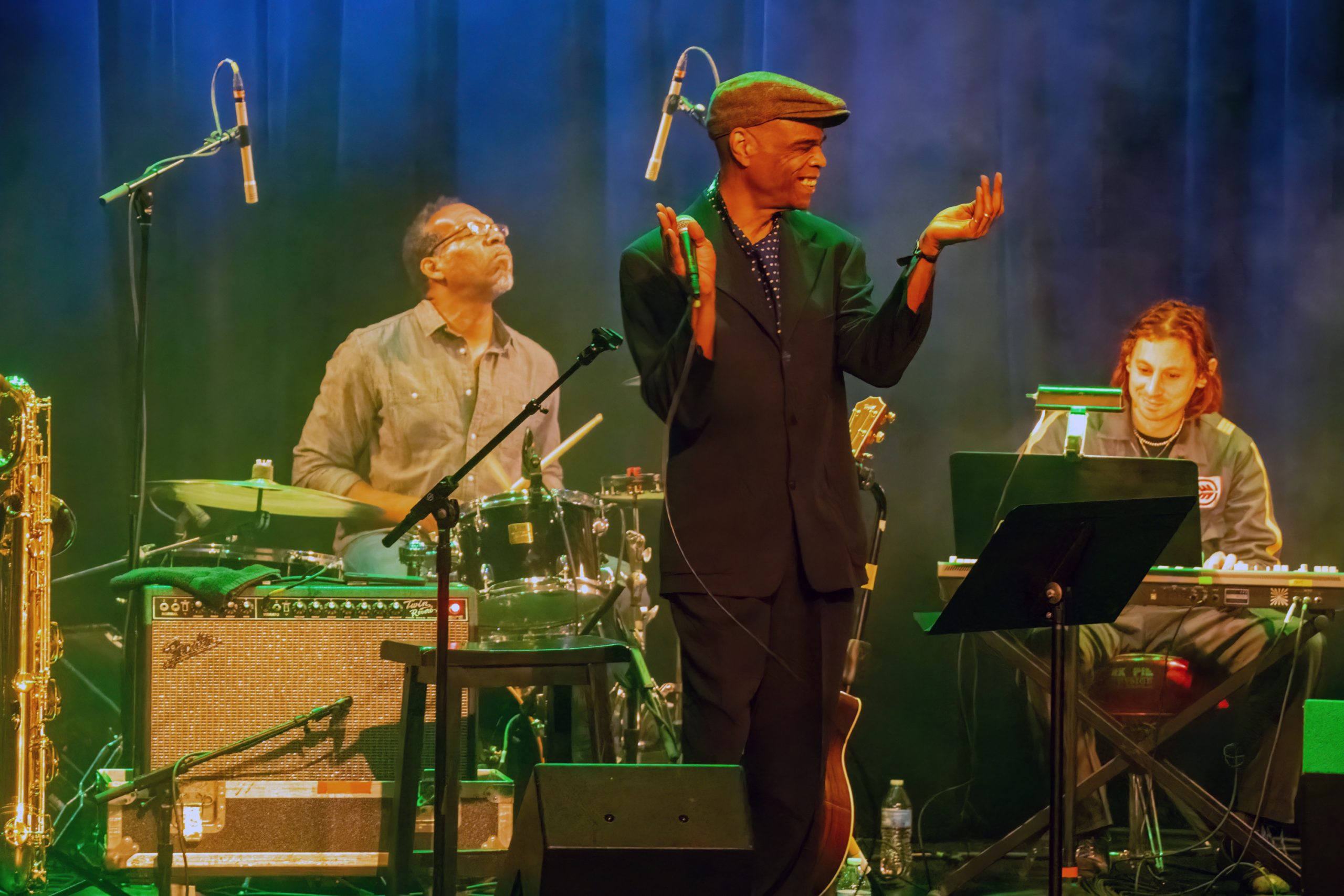
Britt, who is a music-research professor at the University of California San Diego, focusing on teaching computer-based music. On Friday evening, he took over the Mill & Mine, curating a Blacktronika showcase that was one for the ages. Britt’s set kicked off the festivities in spectacular fashion. It featured a heavy, danceable set that had attendees old and young dancing the night away. The setup featured the stage in the middle of the floor at the M&M, much like a Boiler Room session you would see on YouTube, in a London club, with attendees surrounding all 360 degrees around the DJs. Britt set the tone, with the music remaining nearly seamlessly continuous as each performer came to the decks to take a turn at trying to blow the roof off of the venue. When Britt’s set was closing, he proudly announced DJ Heather, who picked up right where he left off.
For DJ Heather, BLANK’s trusty editor and I made our way to the front of the decks to witness the Chicago house DJ work her magic. Heather is carrying the torch for the Second City and is regarded as one of the best in the business right now, and rightly so. The interesting part was in all the pics and bios that I have researched on DJ Heather leading into Big Ears, many of her pictures feature her with a serious look. This was not the case on Friday night, as she flashed a smile that was as big as her sound throughout. Heather’s set was an absolute banger, and as she finished her hour-long dance party, King Britt returned to the platform to announce Suzi Analogue.
All the while, the music never stopped.
As Analogue hit the decks, the style changed slightly to incorporate more hip-hop and soul fusions into the mix. At this point, the M&M was a full-on rave, for lack of a better term, and the attendance swelled throughout her set. The New York City DJ added lyrical layers to her infectious dance beats during the set, a new twist that we had not witnessed from any of the artists up until that point in the evening. We stayed parked at the front of the rail for most of Analogue’s set and were rewarded with a fine experience. (It’s too bad that smartwatches don’t do a good job of calculating dancing into your numbers.) As she finished her set, second-generation Detroit techno legend Carl Craig stepped up as Britt gave it up for Suzi to thunderous applause and announced the legend that was taking us into the culminating performance of the electronic installation.
Craig took over just past midnight and pulled no punches. He went right into a loud, guitar-driven piece accompanied by thumping four-on-the-floor dance beats. Craig’s set was magical, and you would’ve been hard-pressed to find anyone standing with arms crossed in a corner somewhere or not smiling, as the entirety of the M&M was a dance party.
Most in attendance had been there for hours at this point, and with driving rain coming down outside, there was nowhere else they wanted to be.
Craig blew the house away midway through his set with a sped-up version of “C.R.E.A.M,” by Wu-Tang Clan before going back into his traditional numbers. Craig’s set showcased all his diverse musical influences, remixing in samples of music and blending them with his own beats.
Blacktronika was in full effect Friday night, and for those of us who witnessed it, excuse us if we’re a tad groggy today and walking around with stiff necks or sore muscles. Britt did a masterful job of curating the evening, and the stage setup in the middle of the floor felt like the realest electronic music show that I’ve experienced to date. This marathon session was a masterclass in Black electronic music, delivered by the professor himself. – JF