From Western Heights to Sequoyah Hills to Cocke County to Farragut, they come to Positively Living’s Choice Health Network in Knoxville’s industrial neighborhood along Ailor Avenue for hope.
The parking lot is often a patchwork quilt of cars indicating the broad economic spectrum from which the nonprofit’s clients come: old Buicks with Bondo paint jobs blatting greasy clouds of black exhaust parked next to a Lexus so shiny it appears to have rolled off the lot 30 minutes earlier.
Inside the clinic, they line up for clean needles or overdose reversal medication or fentanyl testing strips, all differences in age, race, sexual orientation, religion and social status erased by the twin specters of hopelessness and addiction. They’re all struggling, says Genoa Clark, the harm-reduction director for Choice Health Network in East Tennessee. And while they come to the organization’s office for something specific, they receive some things they seldom find elsewhere: dignity, compassion, empathy and a lack of judgment.
And in that human decency, they find the hope to hang on a little longer, and maybe seek a way out of the darkness in which they dwell.
“People have a stereotype of who they think comes through the doors, but we see folks from all walks of life,” Clark told BLANK Newspaper recently. “Drug use exists on this huge continuum, from abstinence and sobriety to uncontrolled, chaotic use. We see folks who are sober or abstinent coming to get Narcan [naloxone, a treatment designed to reverse an opioid overdose] in case they need it. We also see the stereotypical image that people think of when they picture addicts.
“We exist for those folks, but we also exist for all folks, and that’s who we see. We see them on their lunch break from their jobs downtown, or walking here from downtown because they don’t have housing, or driving from the next county over because there are no services there. And we talk to them. We get to know them, and we learn about their lives, their jobs, their faith communities. We see people from a lot of different backgrounds who don’t have access to what they need.
“The image people have of addicts, it doesn’t encompass the full picture of folks we serve, just as substance abuse doesn’t define everything about their lives,” she added. “And that’s a hard thing to unlearn.”
Positively Living was founded in 1996 “by a few dedicated individuals and a $25,000 start-up grant from the Robert Wood Johnson Foundation to assist in the care of those living with HIV and AIDS,” according to the organization’s website. In 2018, the organization launched Choice Health Network, a joint 501(c)(3) nonprofit designed to serve “East Tennessee’s most vulnerable populations: nearly 6,000 individuals and families struggling to survive the challenges created by HIV, homelessness, mental illness and substance use.” According to publicly available nonprofit filings, it’s an operation that documented more than $10 million in 2022 in expenditures (almost 93 percent of which were the expenses of the program services it offers). Much of the funding comes from state and federal grants – the U.S. Department of Health and Human Services and the Department of Housing and Urban Development, for example – and individual donations, and finishing the year in the black, small though the number may be, is an indication of just how much effort is given to the cause of helping some of the state’s most vulnerable residents.
For Clark, given her background, joining the team of nearly 50 staff members spread out across four cities and operating on a budget of roughly $8 million marked quite a change in direction. With a bachelor’s degree in psychology and a master’s in health policy, she had spent three previous years as a public health analyst for Appalachia High Intensity Drug Trafficking Area (HIDTA), an organization that coordinates and supports drug enforcement efforts by local, state and federal law enforcement agencies.
“Focusing on drug use is obviously part of what we do, but it’s not the full picture,” she said. “Our operation, largely, is made up of three big components: the medical component, where we run the clinic that provides HIV testing, treatment, prevention and a full-service pharmacy; clinical care that focuses on therapy and mental health, food, housing and transportation support; and harm reduction, where we offer a needle exchange service, naloxone distribution, fentanyl test strips and resources for our neighbors who use substances.”
As a “one-stop shop” for the marginalized and disenfranchised, Choice Health Network – and the harm-reduction program in particular – often find themselves fighting an uphill battle against public stigma. Just 10 counties in Tennessee have syringe exchange sites, mostly because of public misunderstanding of why such a service is actually supportive of public health initiatives.
“We recognize that folks are going to use drugs, and they probably always will, so can we provide something that will be safer and lessens public health concerns while helping these individuals preserve their dignity?” Clark said. “We’ve seen a lot of folks in our community, and a lot of organizations, come around to the idea of harm reduction, and the ways that pooling resources together can better serve the population and the community. But there’s still a little bit of a pushback, and I don’t know if we’ll get to a place where we can address these issues if the judgment and stigma stay at the same level.”

One of the myths Clark and her team face is the idea that the harm-reduction program encourages continued drug use and does nothing to promote recovery. Nothing could be farther from the truth, she said: Choice Health Network has many drug and alcohol treatment providers to which caseworkers refer patients who want to get help. The organization works closely with others in the community whose mission is to reduce the impact of addiction in the Knoxville area, which has been plagued by more than 300 overdose deaths this year alone, according to figures from the Knox County District Attorney General’s office.
Giving out test strips, which can be used to test street drugs for traces of the deadly narcotic fentanyl, is one way to cut down on those deaths. Giving out overdose reversal kits, gathered in conjunction with peers at Metro Drug Coalition, is another way. And taking in dirty needles in exchange for new ones hearkens back to the organization’s beginnings, Clark pointed out.
“We know a lot of cases of HIV are among folks who inject drugs, and that includes here in Tennessee,” she said. “On a local scale, our team has identified two clusters of HIV cases in Tennessee since 2019, and we’ve partnered with state and local health departments to investigate. Harm reduction and syringe access are very, very linked to stopping the spread of HIV, and a lot of the folks we test for it are ones who don’t have a primary care physician or a place they feel comfortable walking into and asking for it.
“That’s not a reflection on the opportunities available; it’s more about them feeling safe here and not judged here. Nobody is going to hassle you here, because we’re just encouraging them that, ‘Hey, it might be a good time to get tested.’ Right now, we know that 4.2 percent of the HIV tests we’ve done for folks recently have come back positive – and the baseline for the general population we’re serving is about 1 percent. That’s huge, and it’s probably the tip of the iceberg because there are a lot of folks who aren’t engaged in care and aren’t getting tested.”
In that regard, getting the word out is just as vital to the success of the harm-reduction program as the actual work that takes place in the nondescript office building along Ailor, surrounded by industrial business fronts and shadowed by the concrete superstructure of Interstate 40, on the other side of which lies Fort Sanders. Education is key, Clark said, not just to inform the populations that her organization serves of the ways in which they can be helped, but to demonstrate to the general public that such help is worthwhile.
“There’s just no substitute for coming and seeing the work we do because it’s definitely a myth that it’s just about the needles. It’s about relationships,” she said. “And because we’re located under one roof, there’s a lot of crossover. If you’re here for the syringe exchange and you need to see somebody about housing while you’re here, you can do that. If you’re here to pick up medication at the pharmacy but need a lab visit or to get Narcan, we can make that happen, too.”
Shedding light on what the organization does, she added, helps eliminate some of the stigma – and that, in turn, restores some humanity to the process of helping those caught up in the grips of an illness so often misunderstood but so very deadly: In 2022, according to data from the Centers for Disease Control, 109,680 Americans died of drug overdoses, more than the combat deaths by U.S. military forces in the entirety of the Korea and Vietnam conflicts combined.
Clark points out with no shortage of tragic irony that the increase in overdose numbers – which continue to rise year after year – means more families are affected, and more survivors are coming in for Narcan to keep on hand, in hopes of preventing such overdoses from claiming additional lives.
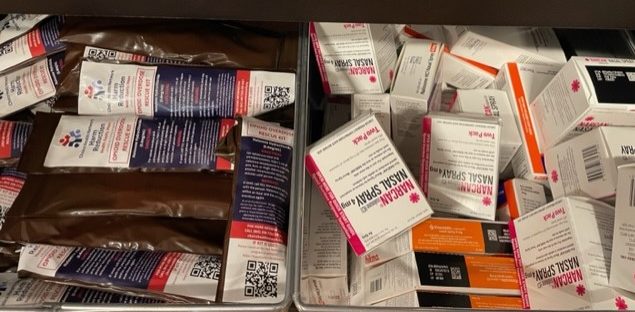
“We’ve seen a lot more people come to get Narcan from us, which is why we stock up at the front desk,” she said. “We want people to have it, and us having a brick-and-mortar location has helped. Every single week, we get somebody coming by who knows that there’s Narcan access here, and now we’re putting it outside for folks to get after hours. And that’s a good thing because it’s going to take all of us working together to combat some of that stigma and make sure we have what we need.”
From April to June, the harm-reduction team has recorded an average of 1,000 one-on-one interactions each month with people who use substances, providing supplies and education as well as connections to other care. Nurses have been deployed on 300 visits to care for wounds and encourage healthy behaviors. More than 20,500 doses of naloxone have been given out. And they’ve received more than 500 reports of people reversing an overdose using that naloxone … including from Daniel Maxwell, who serves as an accountant contractor for Positively Living.
“Over the past 6 months, my friends and I have twice revived individuals from overdoses occurring in the downtown Knoxville area,” he said. “As completely shocking and unexpected as it is to encounter someone overdosing while operating a vehicle stopped at a busy intersection or sitting at a park bench, it is becoming more common. It is important for us as fellow citizens in society to not only help these individuals get the help they need but be prepared to help them in these unexpected situations. While we can never be responsible for their choices, we should seek to be the best neighbor we can to these individuals.”
And that, Clark added, is what Choice Health Network strives to do: meet people where they’re at, with the acknowledgment of their humanity and empathy for their situations and use the resources available to lead them toward the light.
“I really think harm reduction is a bridge to whatever folks think is the next most important thing on their journey, and we’re just trying to affirm their choices and the decisions they want to make, and to help them get there,” she said. “I see the bigger part of our work as building trust and relationships, as giving support, as letting people know when they walk in the door they’re not going to be judged for what they do. Whatever they want to talk about, that’s what we want to talk about. Wherever they want to go, that’s where we want to go.
“We’re trying to put power back in the hands of people who haven’t always had it, and we just want them to know that their decisions are valid, and that we can get where they want to go on their journey. And I think some folks don’t understand that because they feel like some of what we do is enabling. But there are decades of research that shows folks are going to use drugs, and this is a way to help folks protect themselves and our community. We’re just a bridge to other places and opportunities, and that’s the heart of our work: to link people to things they need and to let them know we care about them and don’t want them to die.”
wildsmith@blanknews.com