An Unearthed Time Capsule From 2002
It’s April 2020 and a novel coronavirus just pulled the rug out from underneath the entire music industry. Like so many others, Tim Regan, co-owner of Nine Mile Records / Nine Mile Touring, suddenly finds himself with a lot of time on his hands. One afternoon, listening to old records at his childhood friend Brad Carruth’s house, Tim has an idea: “Hey, what do you think about this? I’m gonna call Kat. It’s not out there. This isn’t about making money. It would be great if something happens and you guys make a lot of money, but this is more about just getting the stuff out and making it available to everybody.”
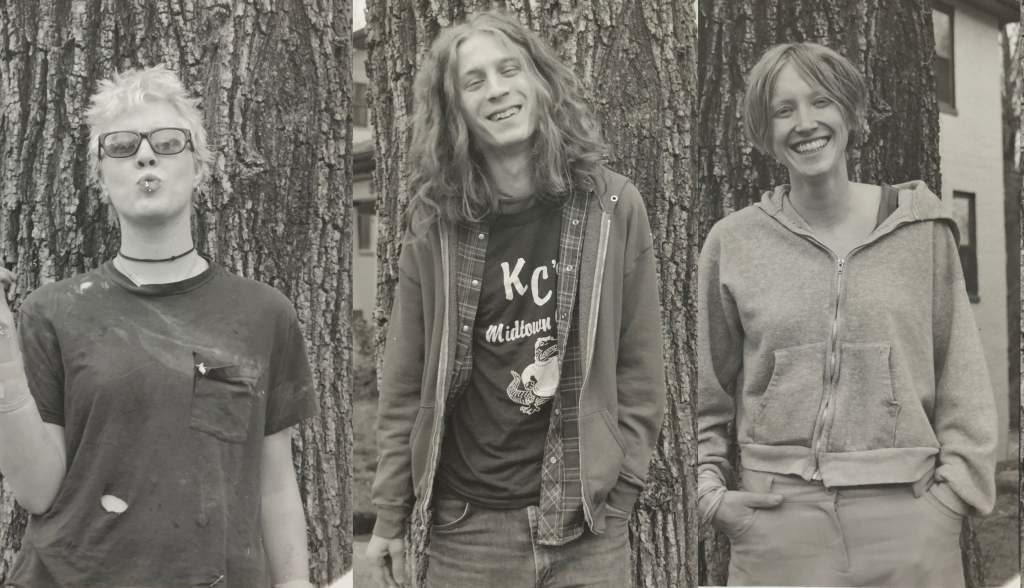
“It” being the long forgotten 2002 album Springtime Is for the Hopeless and Other Ideas by one of Knoxville, Tennessee’s most beloved underground indie rock bands named (brock carruth santos), formerly known as Dixie Dirt. For those of you who still remember – and those of you who don’t – (brock carruth santos) weren’t just a band of music, but rather an anchor for a group of people who related on a certain level. They were a community anchor. They were a band of misfits trying to make sense of a world that didn’t always embrace them. (brock carruth santos) did not necessarily fit people’s perception of a “normal” band, when looking at it through a binary lens. “Growing up in a small conservative town in Tennessee was not easy for a gay person,” says Angela Santos (keys, guitar and vocals). “I didn’t really fit the picture of a band.”
Their music was their outlet. “Springtime is an early dissertation of Kat Brock’s powerful ability to weave her own vulnerability into her art in a way that makes it all unconditionally accessible to anyone who has ever experienced any emotion beyond the pale,” says Santos. Listening to their music, one cannot deny that Kat Brock (lead vocals, lead guitar) wrote songs not just from the heart, but from deep down in her soul. It was Santos’ job to translate Brock’s emotions. Santos knew how to use the right kind of tension to amplify those emotions beyond Brock’s words. And Carruth (bass) added the harmony to round it all out. Together they created powerful, raw, honest music.
(brock carruth santos) put their songs out the way they wanted to. It was never about trying to be trendy. Their music had a way to capture an emotion to the point where it didn’t even matter what they were saying. This is also what makes their music so relatable, even years later. And that’s why – just like a certain scent can take you back to a very particular place and time – (brock carruth santos)’s music has the power to transport you back 20 years, making you feel exactly like you did in that moment in time.
“Why does it do that? Why does it have that effect? It’s so weird. I just wanna drink some beers and smoke some rolled cigarettes and lie in my back yard and listen to it really loud on headphones,” chuckles Kat Brock. “That’s the fun.”
Brock says Springtime was always considered a fan favorite. The album, which simply served to capture a live set was released quietly among a few fans & friends in the regional music community in 2002. There was never any commercial intent behind its release. And maybe that’s why it was overshadowed by subsequent albums, which drew bigger attention than Springtime. The band eventually broke up and Springtime was forgotten and left out of their available discography. “We were just these heroes [to our fans], like we were going to be the next Nirvana out of a shitty small town,” remembers Angela Santos, “and then we just dropped off the face of the earth.”
Or so it would seem. Until that April afternoon when Tim Regan found himself at Brad Carruth’s house and decided in that moment that it was time to remaster Springtime so it could be shared with the rest of the world. “I kind of think there is this treasure trove of records that changed my life but that aren’t available or never made it through to the iTunes world,” says Regan. Carruth and Regan took it upon themselves to dig through some old stuff and by a stroke of luck stumbled upon some demos, “and this thing was on it,” Regan recalls. “I had listened to this album so many times that putting it back on, it was pretty easy to remember everything about it. So I kind of just cleaned it up a little bit, put a little EQ on it. And the main thing is, I felt that it needed a little bit more kick in the butt – like to pull in the base frequencies where the kick drum and the bass were sitting, accentuating those a little bit. That drove it and made it more powerful so you can actually feel it more.”
The results? It’s loud and quiet, it’s analog, it’s beautiful, it rocks and it might make you cry in the car. There are no cool production techniques to speak of and nothing digital was used to make the music. It is just as raw and honest as the band’s live shows in those early 2000 years. And that experience was what Santos hoped the record would accomplish to recreate for all those years. “I just wanted people to feel like they were in the room with us,” says Santos. “I can hear the great care that went into [the remastering of the record]. It was done very delicately but effectively.”
You might wonder: Why the name change from Dixie Dirt to (brock carruth santos), almost 20 years later? “The name change is out of love,” says Santos. “We care about it. We feel it’s important. It feels good to do and like it’s the right thing to do – not just for us, but also our fans.”
Regan released Springtime Is for the Hopeless and Other Ideas under Small Batch Records, Essential Records Volume 1 on June 19, 2020. You can find it on iTunes and Spotify. “I heard it for the first time in years, and it made me cry,” confesses Brock. A lot of die-hard fans cried that Friday morning, too.
Will there ever be a reunion show? Unlikely, if you ask Brock. Never say never, if you ask Santos. One can dream.