Ex Machina questions the ability of artificial intelligence in terrifying form
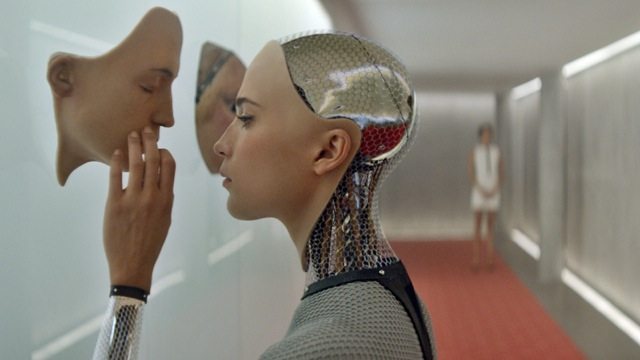
Ever since the dawn of machine, man and metal have proven to starkly contrast one another. One organic and one obedient, technology is the life assistant supporting the foundation of most of our current lives. Everyday, the iPhone gets smarter, Google gets bigger, and the world we live in gets just a little easier with an app or a program or a vacuum that runs itself. This trend is trying to close the gap between human and machine, with the ultimate creation being an entire alias to run one’s life with utmost ease.
So what happens when the gap between intelligence and artificial intelligence closes?
Ex Machina enacts some entirely possible and terrifying paths humanity may take once the creation of artificial intelligence occurs.
While working for Bluebook, an international social media minded search engine, Caleb (Domhnall Gleeson), a bookish middle-of-the-line coder, wins a company wide lottery to spend a week with the website’s mysteriously reclusive CEO. After flying for hours over a vast expanse of Nordic streams and mountains, Caleb stumbles into a monetarily otherworldly house where he meets Nathan (Oscar Isaac), a man as off-putting as he is polite. Very shortly after, Caleb discovers that he was actually brought to the house to test the human accuracy of an artificially intelligent robot Nathan has created named Ava (Alicia Vikander).
Ex Machina refers to Deus Ex Machina, in Latin meaning “God from the machine”. Generally coined for a plot device in which an unsolvable problem is suddenly resolved by the introduction of a new event or character, the film’s title is brilliant on many levels as the introduction of A.I. changes the very structure of not only the story, but the entire world as we know it. Built with a beautiful face, hands, and feet, but otherwise covered in a modern metallic scrim encasing complex technologically advanced prosthetics, Ava is astoundingly human. Her form, an astonishing feat of CGI, gives a new dimension to the Uncanny Valley theory, in which near human animation is disturbing on a strange primal level. Usually a sales-stabbing animation blunder (see The Polar Express), writer director Alex Garland manages to use it to the film’s success, leaving the audience equally mystified and seduced by Ava’s striking humanity through the wires.
Unlike many past movies about the subject of man-made life, Ex Machina’s plot organically folds around the concept that this discovery will utterly change everything around it. The film’s tension is constantly bubbling, and the stale empty house slowly becomes more and more unsettling with each chapter of the film as Nathan’s warped intentions slowly drip into light. Gleeson and Vikander are fantastic in their roles, but Isaac can add the movie to his personal collection of what would be breakthrough roles for anyone else. The entire suspense of the piece rests on Isaac’s maniacal shoulders, and the delirium of trying to break down his intentions is an effect modern horror movies only dream of.
Terrifyingly suspenseful, Ex Machina’s horror is a reality that scientists have warned of for years, and one that could potentially bring an alarming change to the world instantaneously. If it’s anything like the movie, we’re all doomed.