South Knoxville’s new music venue is powered by two men who are fans first
Long before Brian Coakley and Scott Campbell began turning an empty building on Sevier Avenue into a 420-capacity live-music venue, they were another couple of dudes in the crowd, chasing bands from room to room and soaking up the peculiar alchemy that occurs when the right music, the right people and the right place collide.
After years spent booking shows, playing them, producing them and watching Knoxville’s music scene repeatedly reinvent itself, they’re attempting something bolder than just opening another club: They’re building the kind of room they’ve spent years looking for.
For Campbell, the story of The 808 begins with a friendship that was forged through music long before either man was contemplating ownership of a venue, when Coakley was working as a talent buyer and booked Campbell’s bands. The pair chalk up their synergy to a serendipitous connection dating back to before they even knew one another. Both had lived in Orlando in 2004, and both had attended shows by bands such as Slayer and other acts they remember seeing at the same time and in the same venues. And although they’d somehow managed to remain strangers through all of it, once their paths finally crossed in Knoxville, the relationship became something considerably more durable than a promoter-and-musician acquaintance.
Campbell describes Coakley as his best friend of nearly 15 years, and when he talks about why their partnership works, the answer isn’t an explanation of complementary skill sets so much as a simpler foundation of trust.
“The best partnership is having someone that you trust with everything, absolutely,” he says. “And that’s Brian with me, and I’m sure the same goes with him.”
That history matters, because The 808 didn’t emerge from a sudden realization that Knoxville needed another place to sell tickets. It grew out of two people who had already spent years experiencing live music from opposite sides of the stage and thinking about what they loved … and what they’d change. The building at 808 Sevier Ave. eventually became the physical expression of those accumulated experiences.
Campbell had owned a roofing company, Eco Roof, with Coakley serving as its administrator, and the two eventually began talking about creating a small venue in the basement of 605 Sevier Ave., a roughly 100-capacity room that would have occupied a much smaller corner of the neighborhood. But when those plans fell apart after the building owner decided not to move forward, the idea itself survived and changed scale.
Coakley, Campbell recalls, was tired of the headaches associated with large venues and wanted something in the middle; Campbell, who had spent years playing in metal bands, immediately understood what that meant because the rooms in which he had always felt most at home were not enormous concert halls but smaller places where a band and an audience could occupy the same physical universe.
“I never played big ones,” Campbell says, sitting in the slowly emerging interior of The 808 on a recent Friday afternoon. The black interior offers a cool respite to the punishing heat outside, and the venue’s stage is stacked with speakers and other sound equipment just waiting to be plugged in.
“I always played rooms like this,” he says. “This is where my comfort zone is.”
Coakley’s relationship with live music reaches back even further to an experience that happened when he was 18 and had not yet begun to imagine where his fascination might eventually lead. He went to Bonnaroo in 2004 largely because Primus, his favorite band at the time, was performing, arriving with the relatively narrow musical palette of a teenage metalhead and encountering something vastly larger than the particular band that had gotten him through the gates. The size of the stages, the sheer number of people and the staggering amount of work required to make the festival function left an impression that never really went away. What he saw was more than a collection of performances; it was a temporary community built around music.
“The community was so vibrant,” Coakley says. “Everything about the event was so incredibly inspiring and life-changing that afterwards I just knew that I had to figure out how to be involved with live music for the rest of my existence.”
That philosophy helps explain why Coakley and Campbell have paid such obsessive attention to details that might seem mundane from outside the business: where the stage sits, how the sound behaves, how the room is insulated, how many people can occupy the floor without making the place feel cavernous, how the lighting interacts with the performance and whether the building itself can disappear enough for the audience to become immersed in what’s happening onstage.
They aren’t just trying to put bands in a building; they’re trying to reproduce – and perhaps improve upon – the perfect storm of art + sound + building that made them want to spend their lives around live music in the first place.
That opportunity exists largely because The 808 wasn’t originally a concert venue (its most recent occupant, Campbell remembers, was “Drunk Church,” an addiction-recovery religious service), which means Coakley and Campbell were not forced to inherit somebody else’s assumptions about what a music room should be.
“The main thing that stands out for me with The 808 is that it exists in a space that hasn’t already operated as a concert venue or club,” Coakley says. “Every room I’ve worked in before came with somebody else’s decisions already baked into it: where the bar goes, where the stage goes, how much care was put into the insulation, acoustic treatment – or lack thereof.”
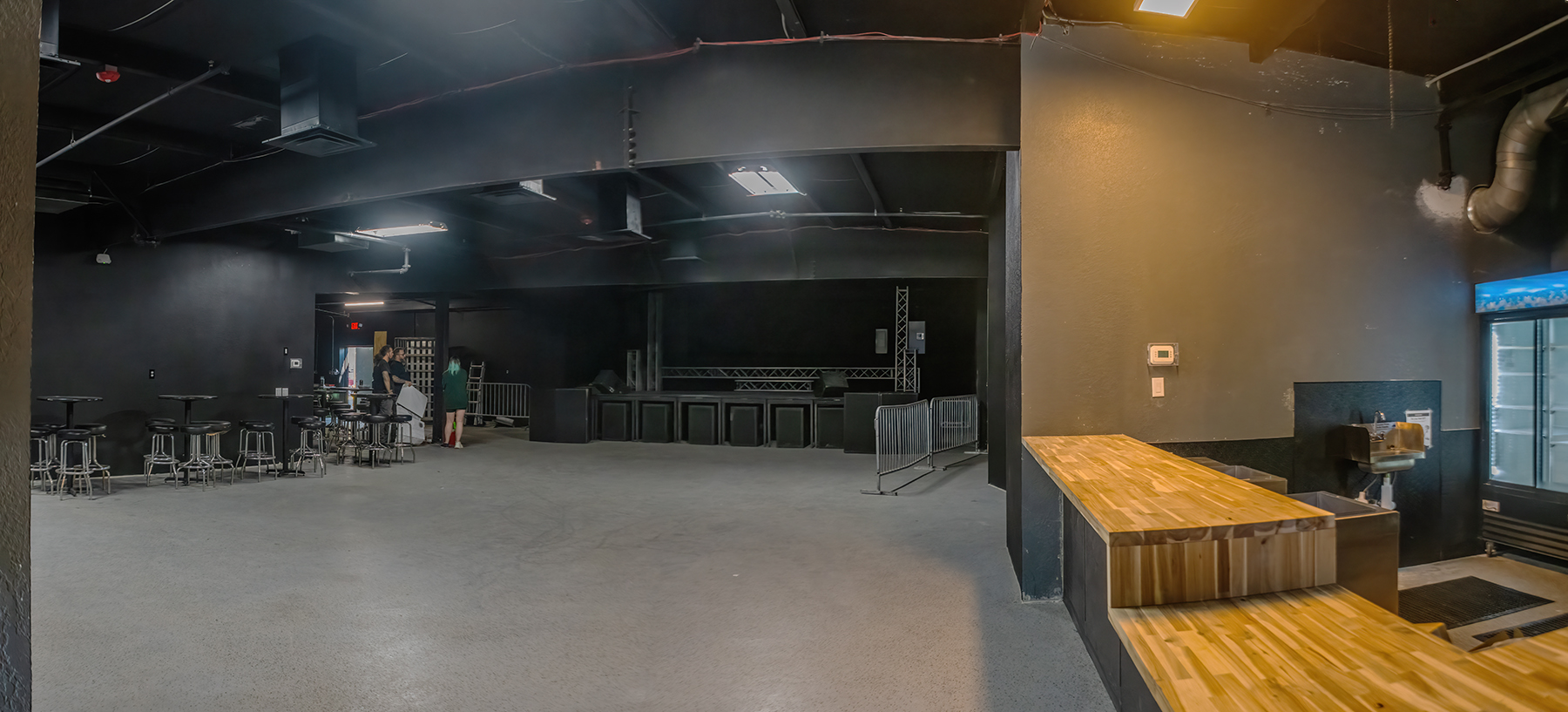
The blank canvas created its own challenges, he acknowledges, but it also allowed the partners to make decisions with the experience of the audience in mind rather than trying to retrofit an existing space around the needs of a concert.
Campbell’s portion of that equation is particularly literal. He remembers bringing his metal band, Shogun, into the building shortly after buying it to rehearse for a festival in Louisville, Kentucky, doing so before the venue had been soundproofed and discovering very quickly what happens when you put a death-metal band inside an unprepared building in the middle of South Knoxville. Police arrived within minutes after neighbors heard the music, an experience that could have been dismissed as an unfortunate first impression but instead became a lesson in what the building would require if it were going to function as a serious music venue.
Campbell subsequently went to considerable lengths to isolate the interior from the surrounding structure, describing a construction system involving the building’s concrete masonry walls, a separate wood frame, rubber isolation mounts, metal hat channels and multiple layers of sheetrock, with the inner surfaces effectively decoupled from the structural framing, so that the soundwaves produced within the venue will be contained rather than transmitted through the walls and into the surrounding neighborhood.
The same philosophy extends to the production itself. The entire back wall will serve as an LED display, while the venue’s lighting system includes numerous moving fixtures. Scotty Cornwell, a DJ, producer and longtime sound-and-light technician who has worked alongside Coakley and others in the electronic scene for years, talks about the possibilities with the enthusiasm of a guy who’s spent a long time imagining what he would do if he ever had the opportunity to control a room from the ground up.
Cornwell and his longtime partner “Oreo” have been DJing together for two decades, and Cornwell says their work has included sound, lighting, stage construction and projection mapping, the sort of accumulated technical experience that makes his role at The 808 considerably more expansive than simply stepping behind a set of decks when the music starts.
The production matters, but what matters more is the why. Coakley says the LED wall, lighting and sound system are things the partners have “obsessed over” because they want the experience to be immersive. But even that answer ultimately circles back to something far less technical than decibels and lumens: human connection.
“We are definitely production-focused,” he says. “We want the experience to feel immersive for people in addition to hopefully having their minds blown wide open by the sounds they hear. The best thing to me, though, is facilitating human connection through the shared experience of live music.”
That is where the distinction between “venue owners” and “fans” becomes impossible to miss, because the people building The 808 keep circling back to the things that cannot be engineered into a building: a group of friends meeting up for a show they’ve planned on attending for months. A couple returning to the room where they first met as fans of the artist on stage. Worker bees in the 9-to-5 grind who part with hard-earned cash for shows they expect to give them joy in return. Coakley says his favorite stories about shows are not necessarily the ones involving the biggest bands or the most impressive production, but the ones in which the concert became the setting for something that lasted beyond the final encore.
“My favorite stories that I ever hear about a show are the ones where people met their friend groups or maybe even the love of their life,” he says. “Those are the things that I hear about that give me goosebumps and really help me feel like I might actually be putting my good where it does the most.”
Cornwell arrives at essentially the same conclusion from a different direction, though his language is blunter, and his philosophy carries the unmistakable edge of someone who has spent years watching musicians, DJs and promoters sometimes forget what the person on the other side of the transaction has sacrificed to be there. He describes himself as a jack of all trades, but the underlying principle of his work is considerably more focused: “We’re stewards of the sound, stewards of the music. That’s all we are.”
That word – “stewards” – suggests that the guys involved in The 808 don’t see themselves as overseers of their particular corner of Knoxville’s music culture as much as custodians of one small piece of something that existed before them and, ideally, will continue after them. Cornwell’s philosophy becomes even more pointed when he talks about what a ticket actually represents to the person standing in the audience. Because the person in front of the stage may have saved for a month to afford a babysitter or rearranged work schedules for weeks to be there, if the people producing the show treat that investment casually, they’ve misunderstood the transaction entirely.
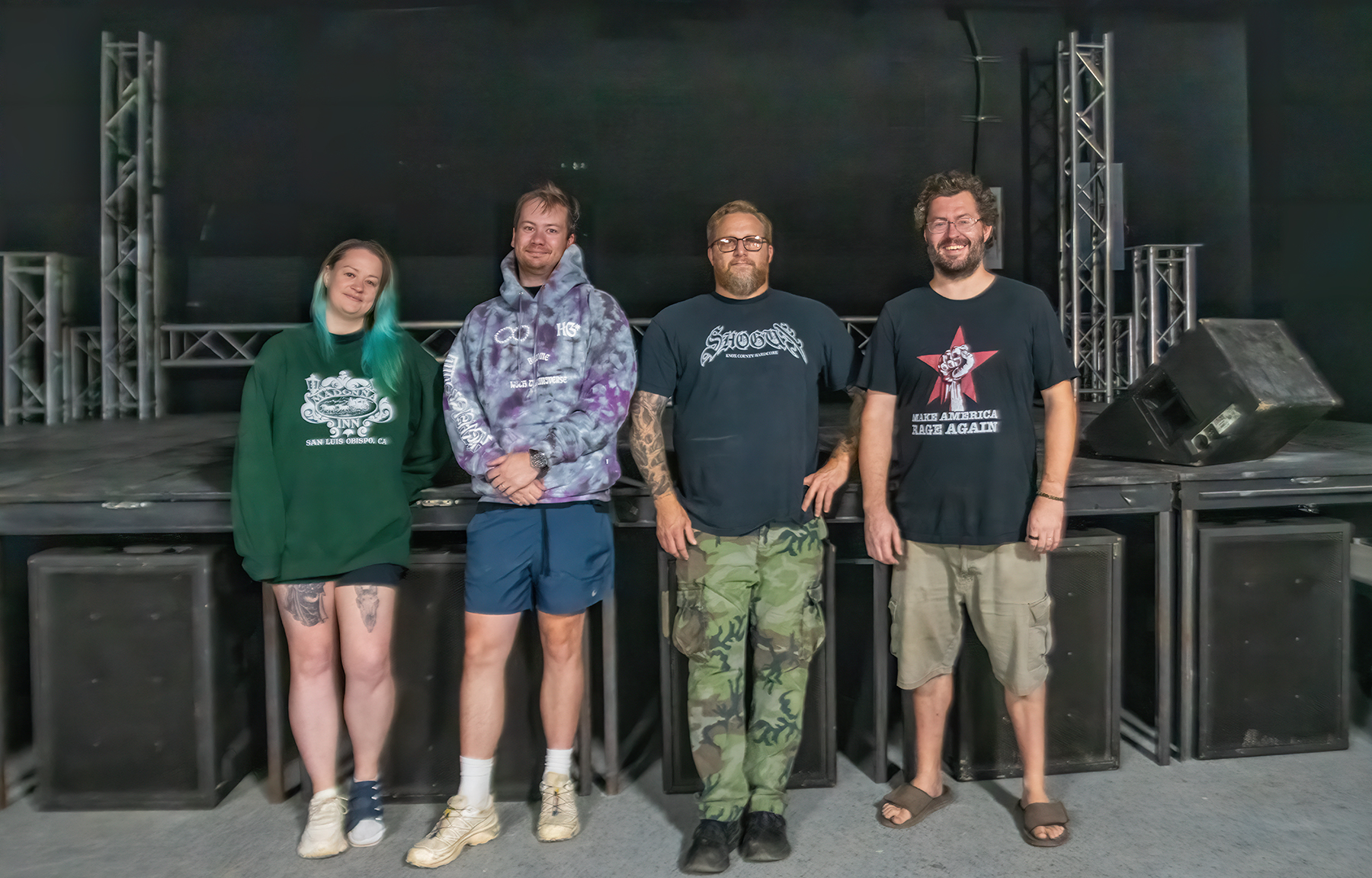
“When you take currency for services rendered, you’re a professional. Act as if,” Cornwell says.
He goes on to describe the responsibility that comes with that power: “(If) you give them the best night of their life, you’ve got a customer for the rest of their lives.”
There’s something almost old-fashioned about that idea, particularly in an era when technology has made it easier than ever to produce music, promote it and fill a room with noise while making it considerably difficult to manufacture the sense of occasion that accompanies a genuinely memorable night out. Cornwell worries that the accessibility of the technology has contributed to oversaturation, allowing performers to think of shows as a paycheck rather than as an act of hospitality and responsibility. That distinction matters to him because the audience isn’t there to watch somebody doing a job; they’ve entrusted the performers with their time, perhaps the most precious commodity they own.
“I want everybody to leave here and think about that night,” he says.
That focus on memory helps explain why conversations about The 808 inevitably drift backward toward the venues that came before it, particularly Blue Cats and The International, places whose significance cannot really be reduced to their capacities or addresses because the people who loved them remember something more difficult to quantify: how it felt to be there.
Campbell remembers Blue Cats as a place where he felt at home, while another conversation about the club turns to its breadth of programming, the way it could move across genres and bring different audiences into the same room. For people who spent years circulating through Knoxville’s music scene, that kind of variety could be its own form of community, a place where a person might encounter something they didn’t come looking for and walk away with an entirely new musical obsession.
Coakley has watched that kind of community change repeatedly in Knoxville, most recently through the aftermath of The International’s closure. Now a part of the Scott and Bernadette West entertainment empire, the building in Knoxville’s Warehouse District was Coakley’s biggest endeavor to date as a talent buyer and production manager. But true to form, the business side was fraught with challenges, and it eventually shuttered … the same way so many other venues in the exact same location had done before it.
This time, the closure hit Knoxville’s electronic music scene especially hard because The International had finally become a place of permanence. EDM shows were the norm rather than the exception, and local DJs and production nights dominated the calendar. It was also the home of Rufus Du Sol’s first Knoxville show.
The scene that had gathered there didn’t disappear, Coakley says; it fragmented, with promoters and artists finding other spaces and adapting to circumstances that were never designed to be permanent.
“It’s been a whirlwind of feelings since The International closed,” Coakley says. “Watching everything split off and go in different directions has been interesting to say the least, and I have a lot of respect for all of the different crews and promoters who have made use of different spaces throughout the city. The scene definitely didn’t die, it just scattered.”
The 808, then, isn’t intended to resurrect The International, and Coakley doesn’t position the venue as some missing piece that’s finally been returned to the puzzle. Instead, he sees the smaller room as an opportunity to create something that may actually be easier for a scene to sustain, a place where local artists can share bills with touring performers and where a room that’s full can create the energy that larger venues sometimes struggle to generate.
“What I’m most excited about with The 808 is having a bit of a ‘home base’ again – somewhere a larger number of people can gather more frequently, and somewhere our local artists can share a bill with a touring act instead of those being two separate worlds,” he says.
That philosophy is reflected in the venue’s capacity. Campbell calls 420 a “sweet spot,” a number large enough to accommodate substantial touring acts but still intimate enough for smaller shows to feel intentional rather than swallowed by an oversized room, while Coakley’s examination of The International’s history reinforced the same lesson from the opposite direction. More than 80% of the shows there drew fewer than 500 people, he says, and the larger room could make even a sold-out audience feel strangely sparse.
The 808 was designed around that problem, Campbell says, with its square footage, restrooms and exits deliberately configured so that the legal capacity and physical dimensions of the room would correspond with one another rather than leaving hundreds of empty square feet around a crowd.
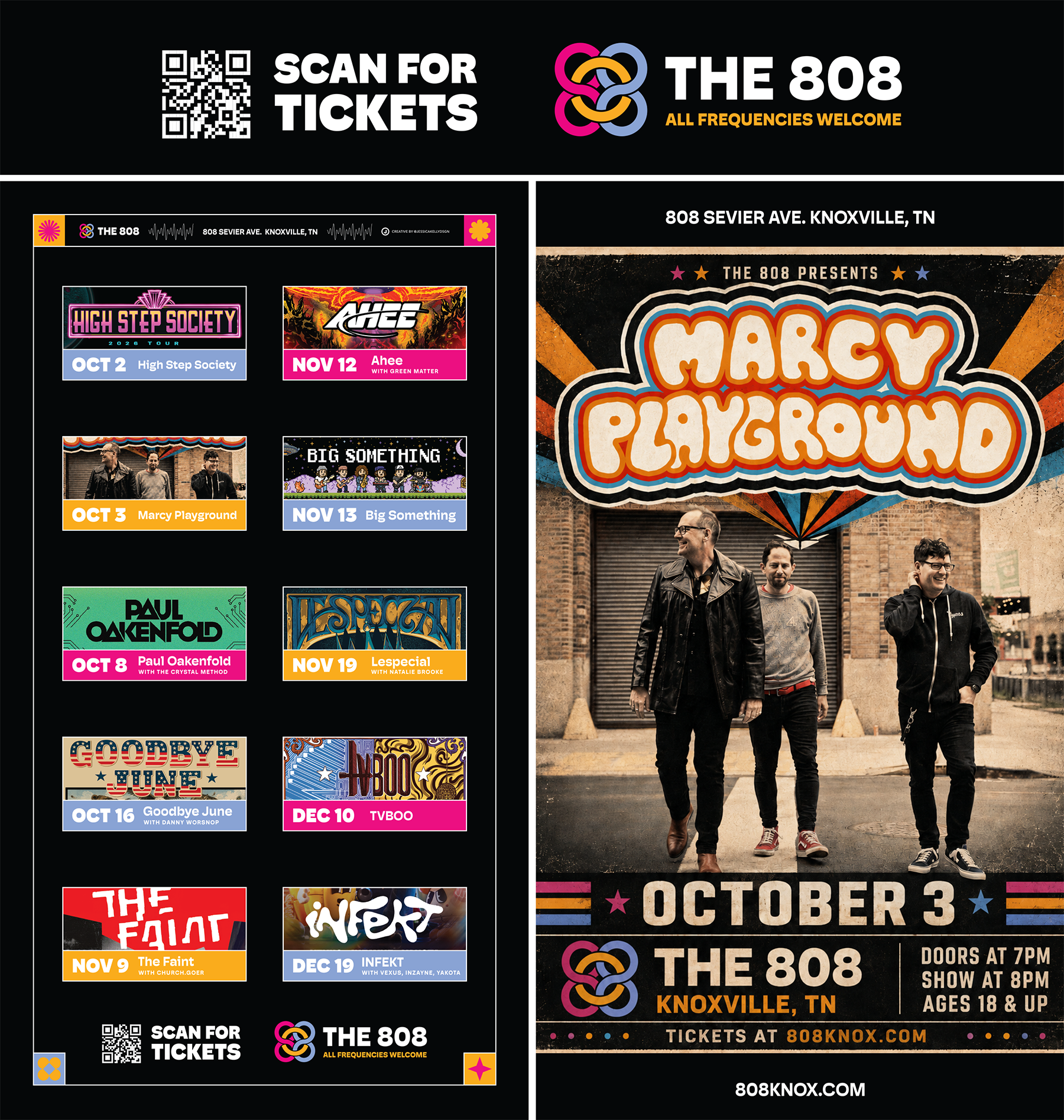
The result is a room that can accommodate artists such as Paul Oakenfold and The Crystal Method – on The 808 calendar for Thursday, Oct. 8 – while still making room for smaller local bills, and that range is important because Campbell and Coakley don’t appear interested in defining The 808 by a single genre or a single audience. Campbell describes a calendar that will include indie rock, country, metal, EDM and local artists, an intentionally broad programming philosophy that recalls the diversity he associates with Blue Cats rather than the narrower identity sometimes attached to individual venues. The goal isn’t to find one demographic and persuade it to keep coming back; it’s to make the building useful to as many corners of Knoxville’s music community as the room can accommodate.
That same openness extends beyond the music itself. Coakley says he wants people to understand that The 808 is intended to be a community-focused venue rooted in collaboration, and that the room is available not only to touring musicians but potentially to nonprofits raising money, artists looking for a place to exhibit work, local bands searching for a stage and groups of people who have an idea for something that hasn’t yet occurred to the people running the building.
“We are open to the infinite possibilities that exist for this space,” he says.
That matters particularly because The 808 is arriving in a South Knoxville neighborhood that already has its own identity, history and music culture, and Coakley is careful to position the venue not as an answer to some supposed absence but as a new participant in a community that was already there.
“We couldn’t be more thrilled to be joining the Sevier Avenue and SoKno community,” he says. “The thing I want to be clear about is that we’re the new folks on the block here. There was already live music happening on this side of the bridge before we showed up, and the spots doing it have been doing it well.”
That humility is important in a neighborhood changing as rapidly as Sevier Avenue, where a new business can easily become part of a larger conversation about what happens when development accelerates and an established place begins acquiring a different identity. Coakley acknowledges that tension rather than ignoring it, noting that a new venue can feel like one more force arriving to change a neighborhood that’s already changing quickly, and his answer is not to deny the possibility but to articulate what the owners hope their presence will mean.
“We take that seriously,” he says. “The goal is to add to the unique character of this street, not to paint over it.”
Practically, he points out, a full house at The 808 will mean several hundred people arriving in South Knoxville on a weeknight, many of whom will eat dinner before a show, have a drink afterward or otherwise spend part of their evening somewhere else along Sevier Avenue or along Island Home Avenue. The venue exists in a neighborhood that already has its own restaurants, coffee shops, bars and gathering places, and Coakley says he and the people involved with The 808 already frequent many of them. The ambition is therefore less about creating a self-contained entertainment destination than becoming another thread in a neighborhood that already has a strong identity of its own.
And that may be the most important distinction between The 808 and the kind of venue that exists solely to put performers onstage: The people building this room understand that, at the end of the night, a great show isn’t necessarily about the room any more than a great concert is the accomplishment of just the band. It’s about the strange, temporary community that forms when hundreds of strangers agree to spend a night together, surrender their attention to the same sound and allow themselves, for a few hours, to become part of something that exists nowhere else and can never quite be reproduced.
Coakley learned that lesson at Bonnaroo when he was 18. Campbell learned it in the smaller rooms where he played metal. Cornwell learned it over two decades of running sound, lights and projections while watching audiences respond when everything finally came together.
All three arrived at essentially the same conclusion: The music is the reason people enter the room, but the room is part of what allows the music to matter.
For all the machinery going into The 808 – the LED wall, the sound system, the lighting, the acoustic isolation, the carefully calculated capacity and the calendar designed to move comfortably between genres – the deepest thread running through the project is still informed by the proprietors’ own experiences.
They remember what it felt like to be the fans walking through the door. They remember the anticipation, the noise, the sense of discovery, the friends waiting at the bar, the band they’d driven across town to see, the venue that somehow became home and the indescribable high of walking out at the end of the night knowing that something happened there that could not have happened anywhere else.
That’s why the story of The 808 keeps circling back to the fan side of the equation. Before they were owners, promoters, producers, musicians or technicians, they were fans – the people standing in the crowd, waiting for the lights to dim and the downbeat to begin. And now they have the opportunity to build a room in which somebody else might have the kind of night that made them fall in love with live music in the first place.
“The best thing to me is facilitating human connection through the shared experience of live music,” Coakley says. “In an era where we are all so glued to screens and the infinite distractions of life, I think real, in-person experiences are more important than ever.”
wildsmith@blanknews.com