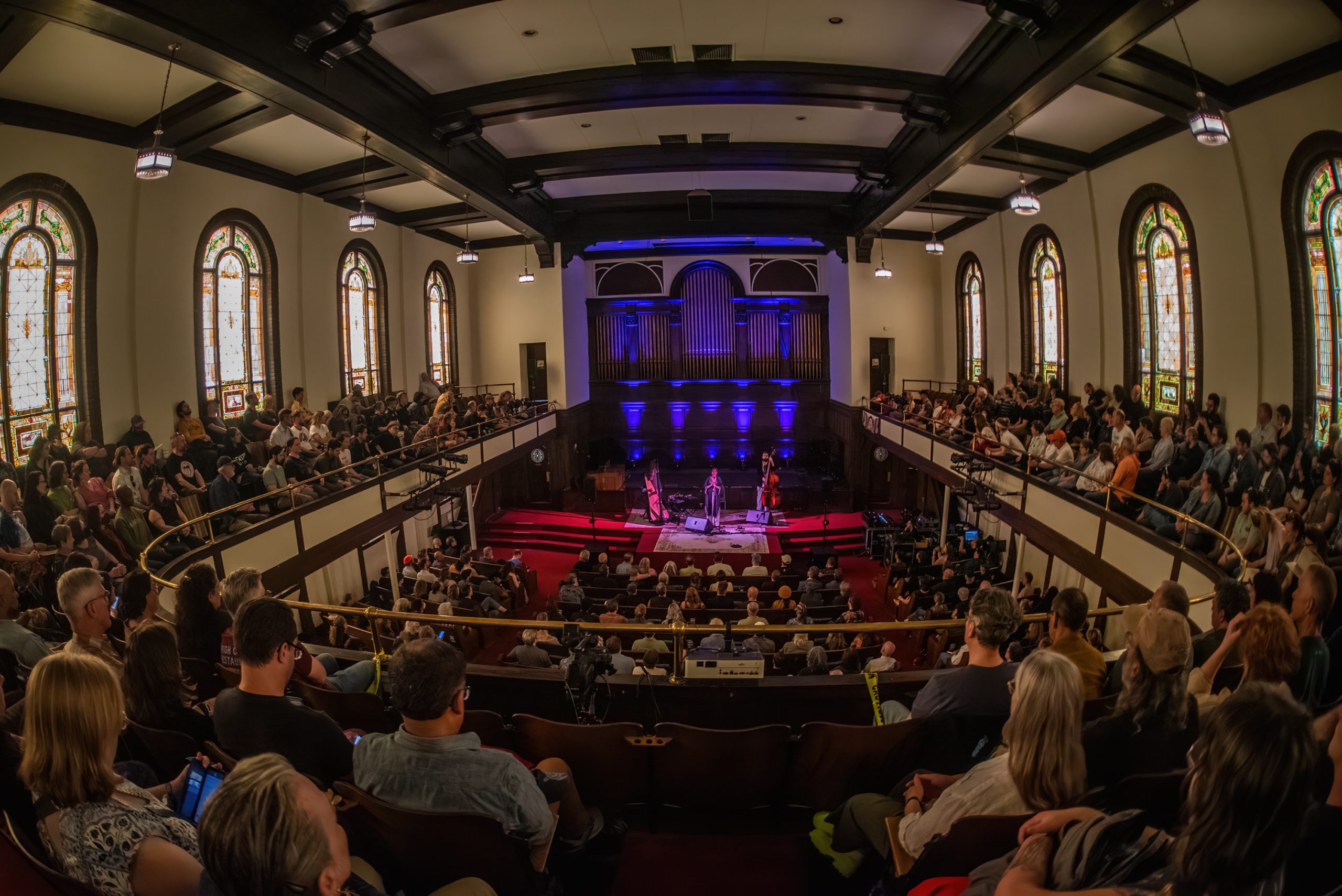
The BLANK crew split up into several groups on Saturday, and while we all seemed to catch different acts, we all bragged about our runs being the best. Respectfully, of course. Here’s a summary of those beautiful stretches, starting with a trio of writings from Wayne Bledsoe.
Wayne: Sometimes you spend a day at Big Ears like you’re sampling a buffet. You have a taste of this and a little taste of that, not getting enough to either become full or tired of it. That was midday Saturday at Big Ears for me. These first three writings exemplified this theme.
Julia Holter
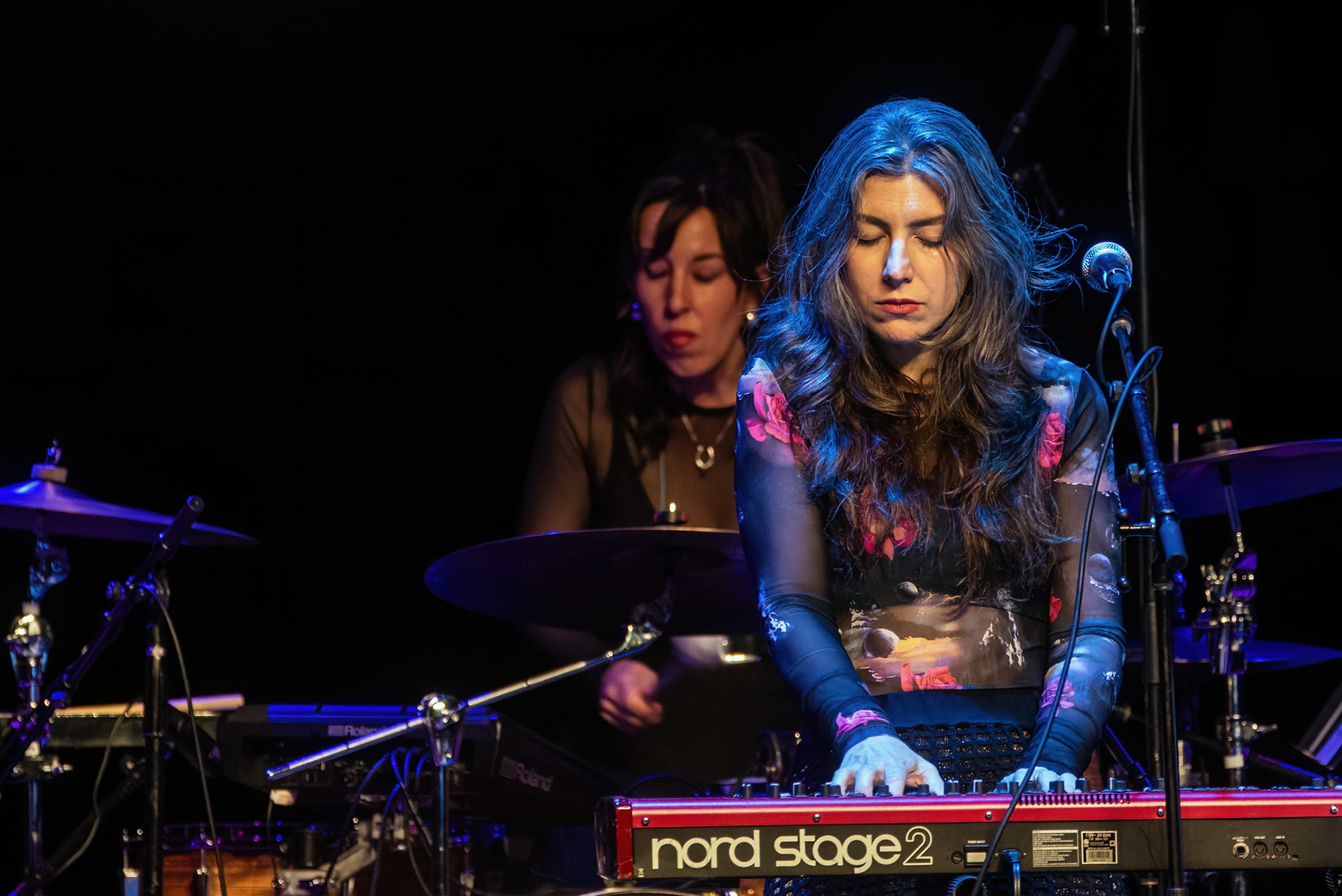
At 3:15 p.m., it was Julia Holter at the Tennessee Theatre. Holter is sort of a classic singer-songwriter with elements of modern pop music, a little jazz and just enough oddness to let you know it’s not entirely familiar ground. While pleasant videos of pencil drawings, hands, and other objects were projected above the musicians, Holter played keyboards and sang songs that were unapologetically pretty. While the players were all talented, the group standout was Devra Hoff, whose fretless bass work provided a sort of punctuation to the songs. I could have spent more time there, but there was too much more to hear.
Sylvie Courvoisier: Chimera
At 5:30 p.m. it was time to catch a little of jazz pianist Sylvie Courvoisier at the Bijou. Surrounded by some jazz legends. Along with trumpeters Wadada Leo Smith and Nate Wooley, bassist Drew Gress, electronic musician Ikue Mori, percussionist Nasheet Waits, drummer/vibraphonist Kenny Wollesen (who sometimes played the vibraphone with a bow), Courvoisier played compositions that seemed like musical questions. It was full of unexpected notes, surprising turns and, at least during the time I was there, few melodies. It’s the sort of music that really takes settling in, but that wasn’t the plan.
Lara Somogyi
Big Ears is one of the best places to hear instruments that are not all that common anymore (or sometimes that were never common) played in unexpected ways. Of course everyone knows the harp, but at Big Ears they seem to be everywhere. Augmented by three violinists, and sometimes adding her own electronics and looping, Lara Somogyi revived the harp as a powerful lead instrument, not the garnish it has become in the past 100 years. Her melodic playing was beautiful and made you want to go back for a second helping. – Wayne Bledsoe
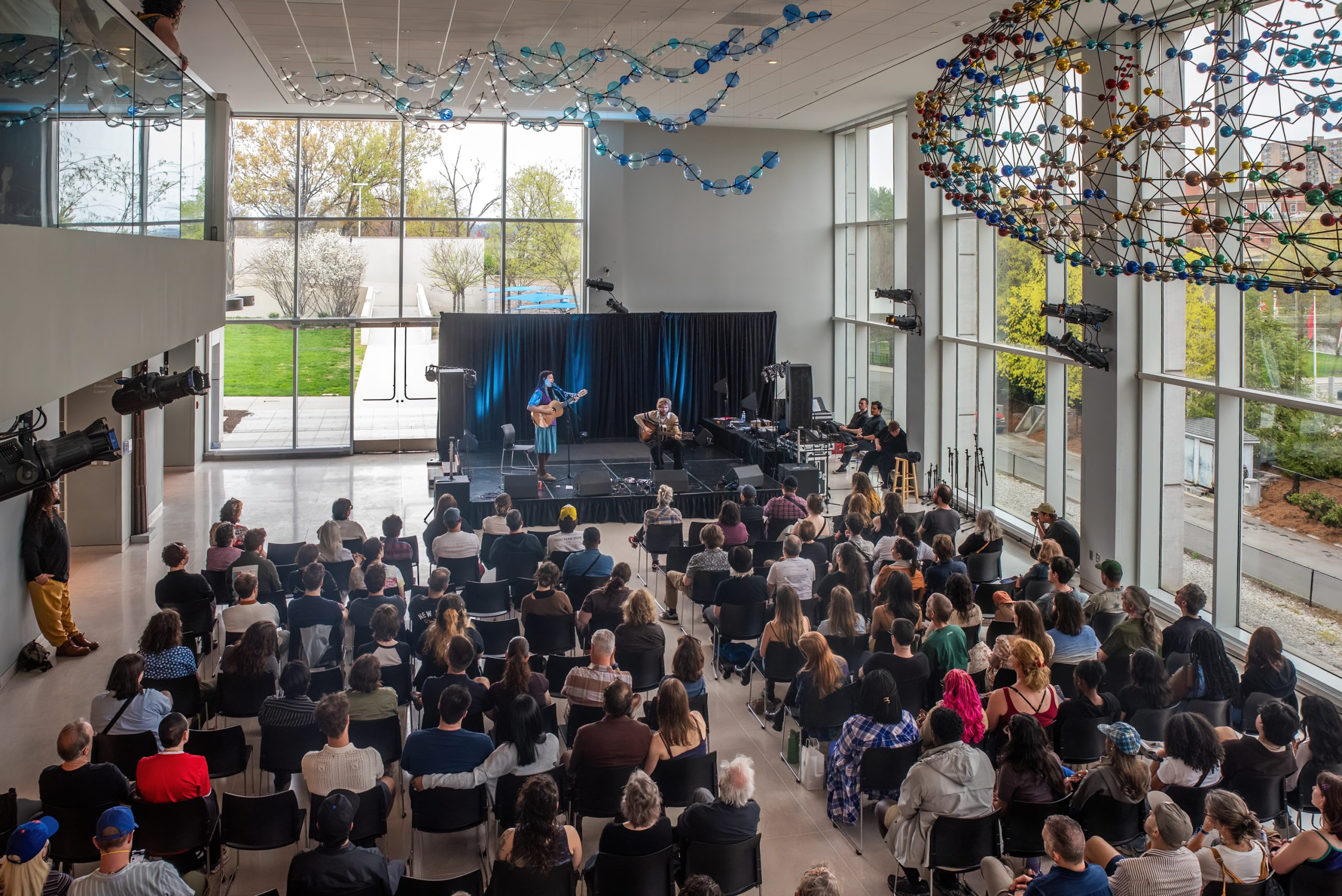
Steven Schick: Kurt Schwitters “Ursonate”
One of the most defining aspects of Big Ears is that it’s a safe and welcoming place for modern and avant-garde classical music in a city where you’d least expect it. To that end, virtuoso percussionist/composer Steven Schick was a perfect addition. His performance at First Presbyterian Church included an all-percussion piece full of bangs and clangs and poundings that was intentional and even emotional.
It was followed with “Ursonate,” a vocal piece by German artist Kurt Schwitters, one of the pioneers of the Dadaist art movement (his works were visual, architectural and finally musical) in the early 20th century. “Ursonate” is a “sound poem” in which real and gibberish words are chosen simply for how they sound. Memorizing such a work is a major achievement in itself, but Schick performed it with aplomb. At one point, he was popping and slapping his mouth and making all manner of vocal clicks and snaps in a piece that was playful and irreverent. No wonder the Nazis deemed Schwitters work “degenerate art” and causing him to flee the country prior to World War II. The Nazis had no sense of humor. We’re lucky the piece survived and those who attended the Saturday performance were lucky to hear it by a master musician with such a good, fun spirit. – WB
Tyshawn Sorey, King Britt & Friends
Nobody has been busier than Tyshawn Sorey or King Britt at this year’s edition of Big Ears. Both artists have played numerous shows and participated in collaborations throughout the weekend, embodying the true spirt of the festival. Saturday afternoon, the two titans got together at Jackson Terminal with friends Melz on guitar and Meshell Ndegeocello on bass to perform an ambitious set that included myriad sounds and styles. The set started slowly with King Britt laying down an atmospheric electronic base which was followed by Sorey’s experimental jazz drumming. Melz and Ndegeocello joined in to help blend a fusion of rock and jazz on top of subtle electronics and Sorey’s genre-bending drumming. Their performance was a special coming-together of four wildly different musicians and styles that turned out perfectly. – John Flannagan
Joe Lovano’s Paramount Quartet

The Knoxville Civic Auditorium has been a welcome addition to Big Ears the last couple years. It looks like your grandmother’s living room, but it has great sound, no bad seats and ample parking for a large capacity. It was mostly full for this surprisingly great show by Joe Lovano and Julian Lange’s new quartet. Lovano is a saxophonist with a long career and 100-plus albums under his belt, while Lange is just getting past the new-kid-on-the-block stage of jazz guitar. Nonetheless, they gel as if they had spent decades together. With a locked-in rhythm section, the two were free to trade lines, play in unison or just have an old-school head-cutting session. It always stayed on the smoother side, and I could have used a bit more noise, but it was a professional, top-notch show and one of the best things I saw at what has been an amazing festival. – Bill Foster
Beak>
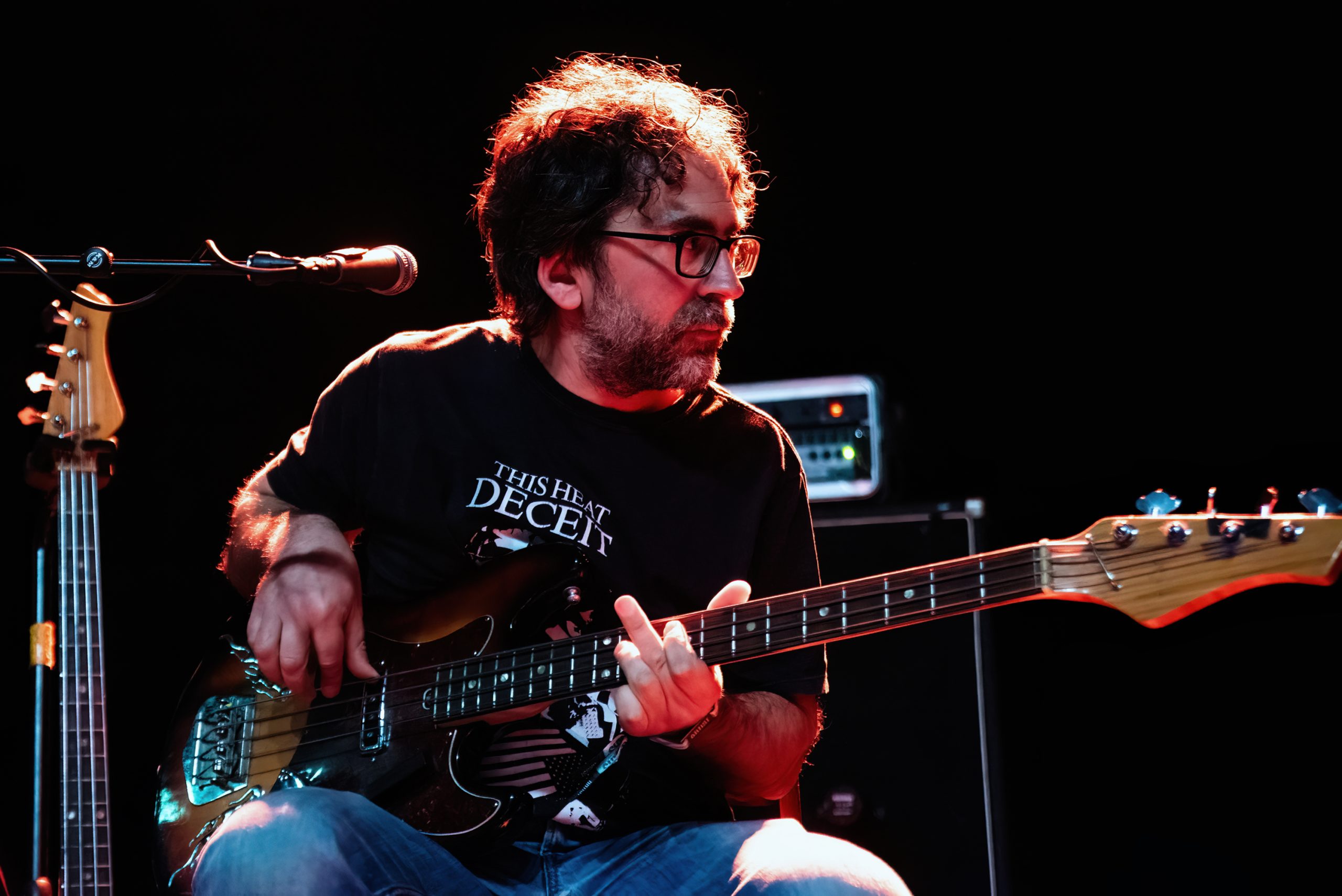
My toughest conflict of the day involved having to choose between Julia Holter and this experimental psych/electronic trio featuring Geoff Barrow in one of his last performances with the group. Having seen the former at the 2014 edition of this festival, though, and realizing the opportunity to catch the latter in general was rare, I opted to hunker down at Mill & Mine for the entirety of this set. Fortunately but unsurprisingly, that decision paid off in droves.
As they have for much of their current tour, Barrow, Billy Fuller (bass, vocals) and Will Young (guitar, keys, synth) opened with the electrifying triptych of tracks that kick off their most recent effort, last year’s “>>>>.” Later returning to that source material on a couple of occasions (most notably for the eerie yet irresistibly bouncy “Secrets”), Beak> peppered the setlist with bangers culled from its previous three albums, as well. Musically diverse, the show included everything from tinkling electronica to trippy rave-ups, delicate acoustic fingerpicking to heavy electric riffs. It was at its best when the players locked into each other’s movements on one of the noisier numbers but was enthralling throughout.
The impeccable execution of the art on display cast an alluring spell that was unexpectedly broken by Barrow’s hilarious between-songs banter. Rather than distracting, however, it served as comic relief, both helping to take the edge off of the seriousness of the music and providing gallows-humor levity in the face of all the chaos and uncertainty swirling around the insulated bubble of Big Ears. – Matt Rankin
Michael Rother: the music of Neu! and Harmonia
It is special to see legends of various genres perform at Big Ears, and Saturday afternoon gave us yet another. Krautrock pioneer Rother performed a set heavy on music by Neu!, a group he cofounded in the mid ’70’s, while sprinkling in several Harmonia tunes, another influential electronic group he cofounded. As Rother’s set wound down, he politely told the crowd, “I believe our time here is almost done,” as he went into his hit song from 1975, “E-Musik,” for his set closer. Rother’s influence cannot be understated, and his billing and performance at this festival were indicative of electronic music’s relevance here. – JF
Lankum
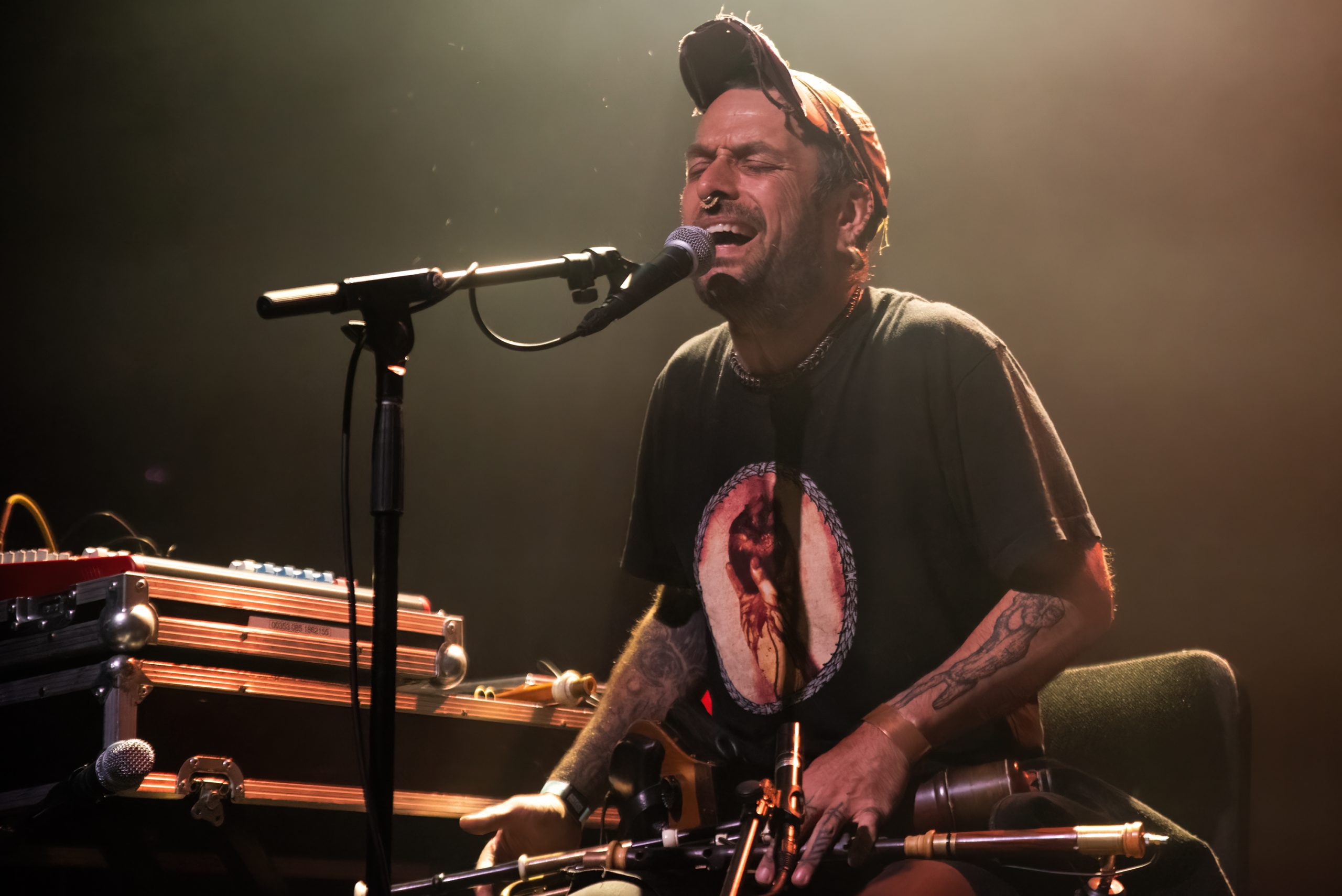
In the worst conflict of the festival for me, Lankum at the Mill & Mine was against DahkaBrahka at the Tennessee Theatre. I chose Lankum, and I am so glad I did. Returning to Knoxville for the first time since playing the Preservation Pub in 2014, the Irish quartet played a transfixing set of originals with a few covers (all of which were completely unknown). Lankum is firmly rooted in traditional Irish music, and if you hear it you will immediately think, “That’s Irish folk,” but it has none of the traditional dancing jigs. Instead, it is all brooding, slow, intense music, punctuated by drones and periods of psychedelic weirdness. All five people in the band sing, and their harmonies are otherworldly. They utilize accordions, pump organs, uillean pipes, stompboxes and an incredible 42-inch bass drum that filled the room when struck. Big Ears is always about the live experiences for me, but this is one band whose discography I cannot wait to explore. – BF
Arooj Aftab
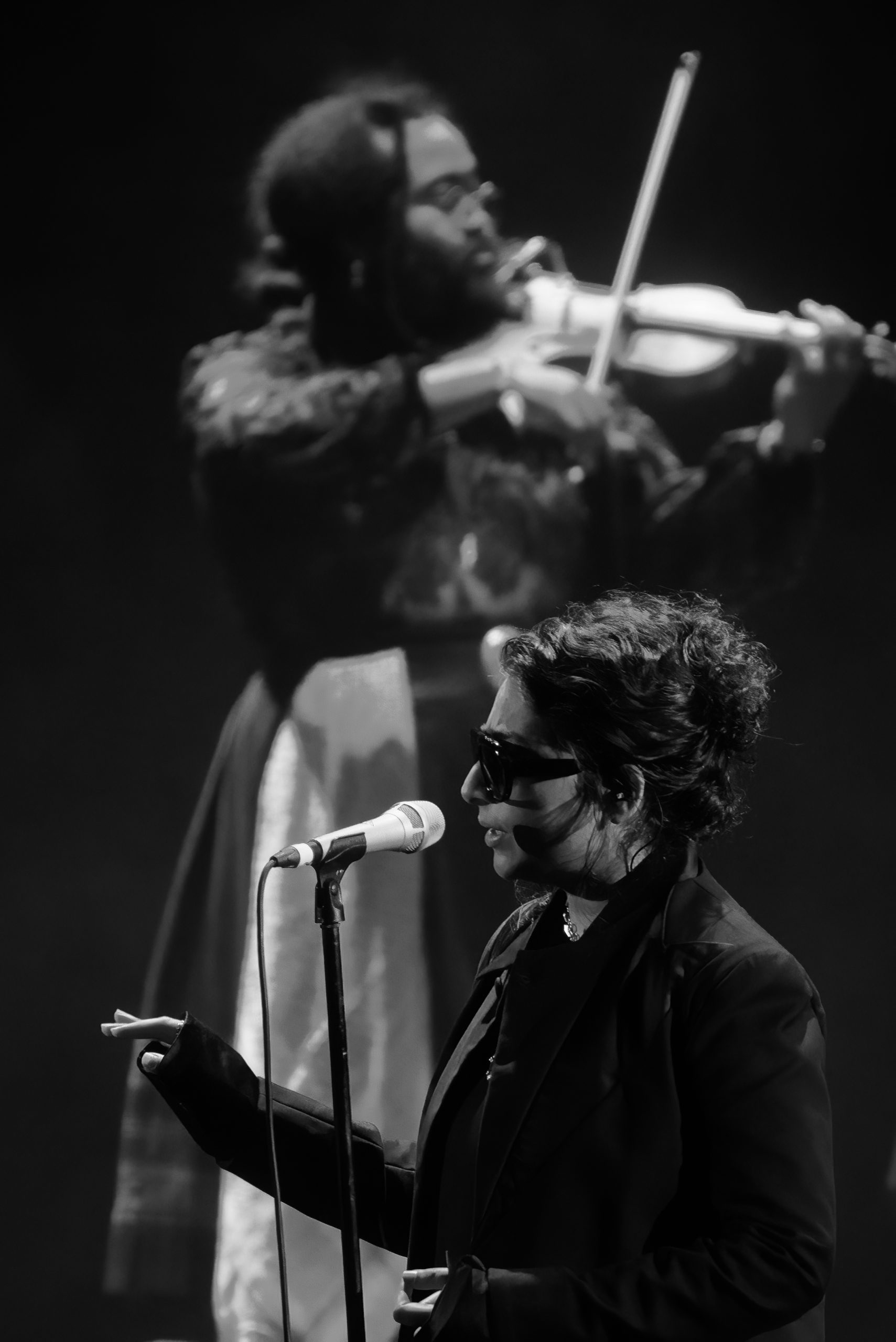
After seeing Pakistani-American singer-songwriter Aftab at earlier Big Ears festivals, she has become one of my must-see artists. I’m not alone. Her last appearance was at the Tennessee Theatre, which was packed to capacity. This year, she was moved to the Civic Auditorium, which, at approximately 2,400 seats, is almost twice as many as the Tennessee, and the venue was almost full.
Although Aftab let the audience know at the outset that a fan at a recent album signing had gotten her sick, she, and her talented musicians, performed beautifully. Her voice is soothing and soulful. Her songs, sometimes sung in her native tongue and sometimes in English, are sensual and mysterious. Aftab dispelled some of the mystery about some of the non-English lyrics during her performance, noting that they were nearly all about relationships. Aftab’s music is an intriguing fusion of Western and Middle Eastern elements that seems both familiar and exotic at the same time. There’s a little jazz to it, a little ethnic folk and an almost pop-standard feel to some of the songs. The arrangements were smart, and, as a bandleader, Aftab understood how to create drama with acoustic guitar, flute, drums and keyboards providing a sweet background until their time to be brought to the forefront of the mix. Any of the instrumentalists could’ve performed a thoroughly entertaining show as a solo act.
Maybe most importantly, Aftab does not set out to grandstand as a vocalist. She understands subtlety and nuance. When she croons out the line, “Last night my love was like the moon,” from her song “Last Night,” it is powerful in the quietest way. She’s serving the song, not trying to show off everything her voice can do.
Aftab is something special. She’s almost worth the price of a Big Ears ticket alone. – WB
Steve Roach
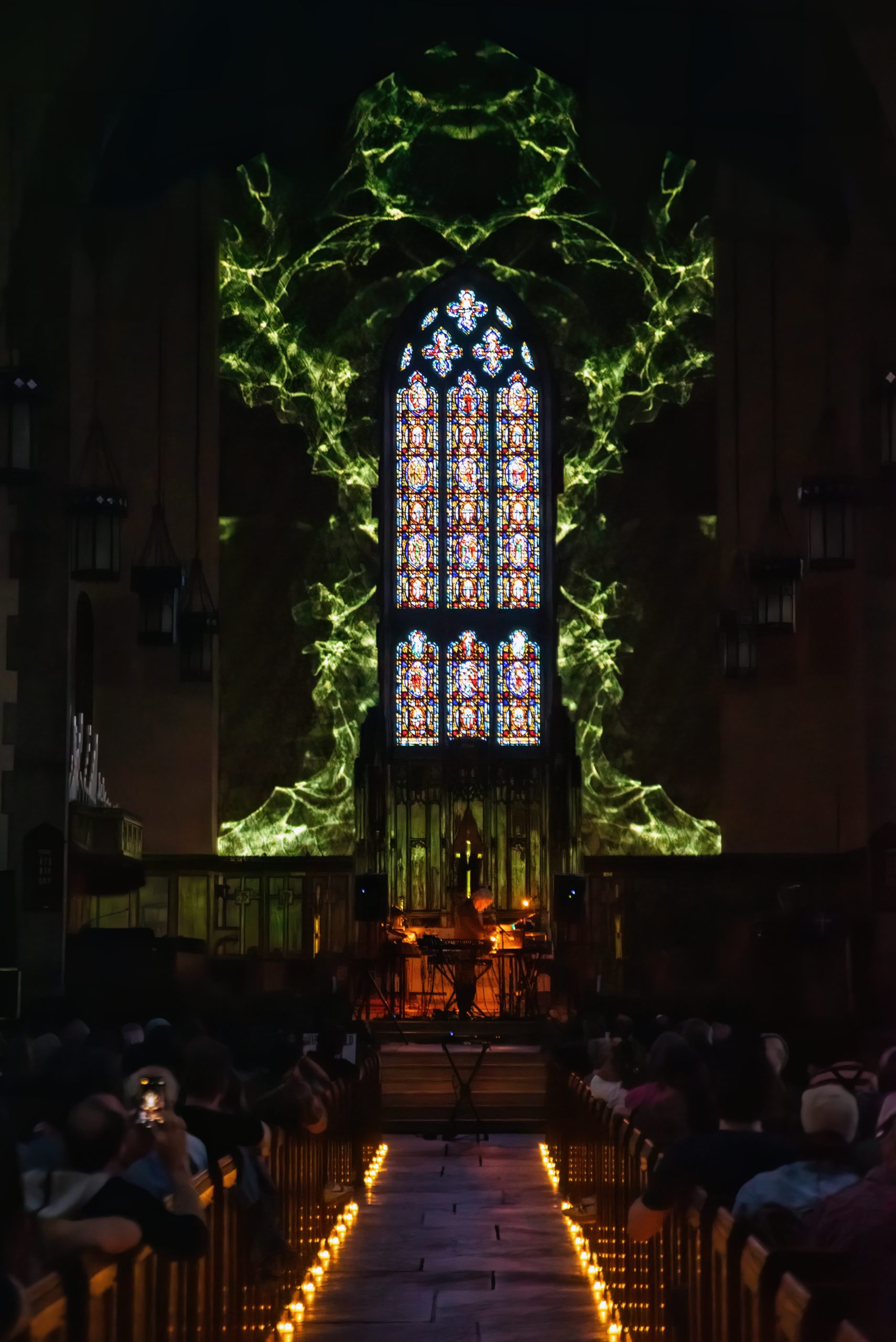
One of the great things about Big Ears is how Knoxville’s unique collection of venues and the experience of the festival can transform music that one might not ordinarily grasp into a transcendent experience. Such is the case with Steve Roach’s mesmerizing set at Church Street United Methodist Church. This was the last show at the venue and thus the last for the light show put on by Age of Reflections. For this concert, AoR spent weeks image-mapping the church and creating maps so that they could program lights to shine on the altar and walls surrounding the central stained-glass windows. Roach plays ambient music that is slow, drone-like and repetitive. He has won two Grammys and recorded 85 albums. His thing isn’t my thing, but that’s what is great about Big Ears. In this beautiful space, with the light show provided by AoR, it became a meditative, trance-like, spellbinding experience. I could have stayed for hours, and it would have felt like moments. Perfection. – BF
DakhaBrakha
Ukrainian band DakhaBrakha have wowed crowds previously at both Big Ears and Bonnaroo festivals, but the passion and power that the quartet displayed Saturday night at the Tennessee Theatre was truly something special. A combination of ethnic folk, rock-music energy and pure magic, the band had the audience on its side from the beginning. With all of its members sitting, the group played cello, accordion, drums/percussion and keyboards, and all contributed vocals. Their image is striking, with the women all wearing tall hats and all in ethnic dress.
Cool animations were projected above the players, while the crowd clapped and stomped along with the heavy beat of the band’s music. Of course, any artists from Ukraine would have plenty to say. Sometimes information about the war with Russia would be projected during the music, contrasting with the song’s sometimes joyous sound. With one raucous number ending with the projected message “Stand With Ukraine,” the entire crowd did indeed stand and cheer. There was no doubt that this audience was in support of a democratic nation that was under attack.
The group’s final act was a musical auction of one of singer-accordionist Marko Halanevych’s paintings with proceeds going to the war and humanitarian efforts in Ukraine. With a bid starting at $300, the work brought $3,000 to cap off the show. It was a nice way to end, but DrakhaBrakha’s entire performance felt like proof that art and beauty can be found even in the most dire and desperate of times and are, in fact, essential parts of life. The group’s entire show felt like church and fellowship in a time when many of us have lost some faith in the people around us. It is a feeling that some of us would cherish long after we walked out of the theater. – WB
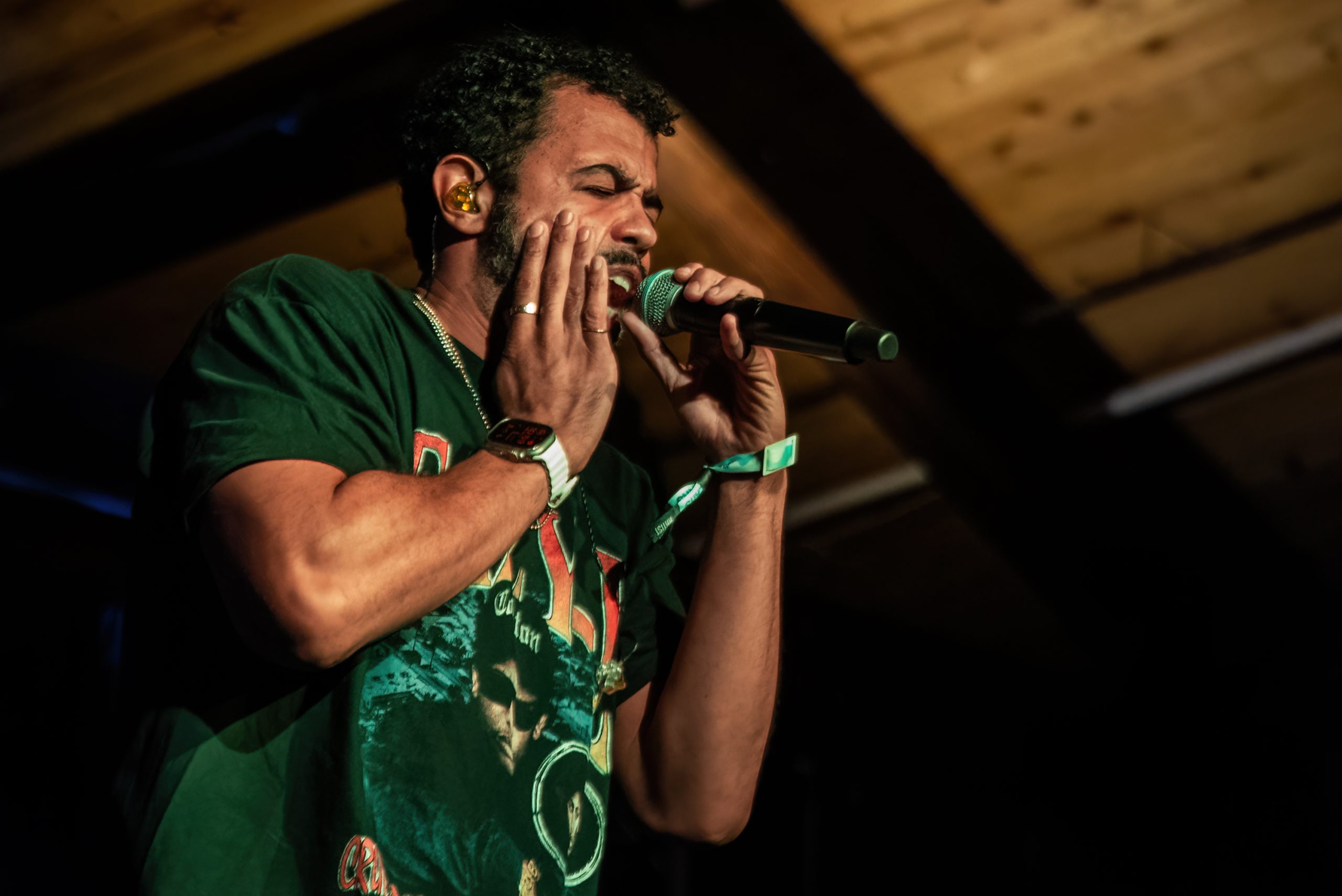
Water Damage
Thor Harris, the gregarious multi-instrumentalist best known for pounding the skins for Swans, began introducing the horde of musicians crowded onstage at The Standard a few minutes before the scheduled 12:30 a.m. start time and didn’t wrap it up until a few minutes after, but such was the number of guests – I counted at least a dozen people from my perch in the back of the packed room, but there could have been more – joining the Austin, Texas, experimental drone band for this special one-piece performance.
Beginning with a soft murmur created by guitar and violin, the composition took shape as more players entered and sparse yet thunderous percussion outlined its form. Though repetitive and unwavering in its steadfast devotion to a singular concept, there was a wide variety of excursions each musician took throughout the 45-minute opus, the feverish, mind-melting polyrhythms conspiring to glorious effect. Watching the ensemble operate in a highly organized lockstep with all the members flailing furiously on their respective instruments was a sight to behold and one of the most impressive things I can recall ever seeing.
The piece surged in intensity before eventually lurching to a satisfying completion, the assemblage in attendance left awed at the spectacle it had witnessed and the participants themselves congratulating one another for their accomplishment. Though leaving a significant portion of its allotted time unused, it was hard to fault the collective for ending early given the focus and exertion required to produce such a masterful work of art. – MR